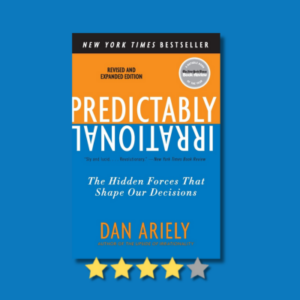
 Review By: Anonymous
Published: 2008
Genres: Psychology, Economics, Nonfiction, Behavioral Science
Audience: Grades 10–12, Adult
Number of Stars: ★★★★☆ (4/5)
Goodreads Link: Predictably Irrational
Content Warnings: Brief mentions of ethically gray social experiments and alcohol consumption in studies.
Publisher’s Summary
Why do our headaches persist after taking a one-cent aspirin but disappear when we take a 50-cent aspirin? Why do we splurge on a lavish meal but cut coupons to save twenty-five cents on a can of soup?
In a series of illuminating, often surprising experiments, MIT behavioral economist Dan Ariely refutes the common assumption that we behave in fundamentally rational ways. Blending everyday experience with groundbreaking research, Ariely explains how expectations, emotions, social norms, and other invisible, seemingly illogical forces skew our reasoning abilities. We fail to understand the profound effects of our emotions on what we want, and we overvalue what we already own. Yet these misguided behaviors are neither random nor senseless. They’re systematic and predictable—making us “predictably” irrational.
Review
Predictably Irrational (2008) by Dan Ariely is a fun exploration into human behavior. It describes the patterns of human decision-making and why people act the way they do. It shows common mistakes that people make and what leads to these illogical decisions. The book explains human decision-making in a scientific, explanatory way, describing many types of social experiments conducted on human behavior. It explains the psychology behind why people may overpay, the power of “FREE!”, and the power of relative comparison. The book even explores the placebo effect and how expectations can shape what we experience.
The book looks at everyday decisions we make, making it perfect for teachers and people in business. After reading the book, I was much more aware of my own decision-making. Often, we as people act irrationally even though we know better. It includes relatable examples of instances we would experience in our own lives.
The book is very readable and easy to refer back to. Each chapter is organized by one key idea or theme. It is a book I would recommend having a paper copy of for easy reference in the future; it’s a book with content to highlight and to write personal notes in the margins. This would be a great book to read with high school students (grades 10–12). It could easily be used in courses for business, economics, social studies, and even math. Overall, I would give this book 4 stars and would recommend it to my friends and colleagues.
🧠 Key Concepts in Behavioral Economics
Ariely challenges the “Rational Choice Theory” (the idea that humans always make decisions that maximize their benefit) by introducing several systematic biases.
1. The Decoy Effect (Relativity)
We rarely choose things in absolute terms; we focus on the relative advantage of one thing over another.
Example: If you have a $3,000 trip to Paris and a $3,000 trip to Rome, you might struggle to choose. But if a third option is introduced—Rome without free breakfast—suddenly the Rome with breakfast looks significantly better than both.
2. The Fallacy of Supply and Demand (Anchoring)
Our first impression of a price (the “anchor”) stays with us and influences how much we are willing to pay for that item for a long time afterward.
3. The Cost of Zero Cost
“Free” is not just a price; it is a powerful emotional trigger. We often give up a better deal just to get something for free, even if we don’t really want the free item.
🎒 Classroom & Curricular Applications
This book is a versatile tool for cross-curricular high school units:
- Economics/Business: Use the chapters on “Market Norms vs. Social Norms” to discuss why you can’t pay your friends to help you move, but you can buy them pizza.
- Social Studies/Psychology: Discuss the “Honesty” experiments. Why do people cheat more when they are one step removed from cash (like stealing a pencil vs. stealing a dollar)?
- Math/Statistics: Analyze Ariely’s experimental data. Have students design their own “predictably irrational” experiment on campus to see if they can replicate his results.
- Self-Help/Advisory: Discuss Procrastination and Self-Control. Ariely suggests “pre-commitment” strategies to help students hit deadlines.