 Review By: Anonymous
Published: 2016 (English Translation)
Genres: Literary Fiction, Latin American Literature, Experimental
Audience: Grades 10–12, Adult
Number of Stars: ★★★★☆ (4/5)
Goodreads Link: Multiple Choice
Content Warnings: Themes of authoritarianism, political repression, and the legacy of the Pinochet dictatorship.
Publisher’s Summary
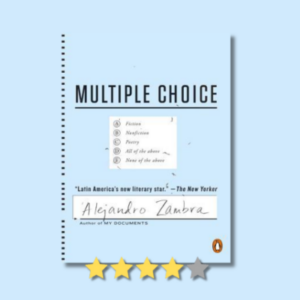
The works of Alejandro Zambra, “the most talked-about writer to come out of Chile since Bolaño,” are distinguished by their striking originality, brevity, and flouting of narrative convention. In Multiple Choice, Zambra returns with a book written in the form of a standardized test.
The novel invites the reader to complete language exercises and engage with short narrative passages via multiple-choice questions that are thought-provoking, usually unanswerable, and often absurd. It offers a new kind of reading experience where the reader participates directly in the creation of meaning. Full of humor, melancholy, and anger, Multiple Choice is about love and family; privacy and the limits of closeness; how a society is affected by the legacies of the past; and the conviction that, rather than learning to think, we are trained to obey and repeat.
Review
Multiple Choice (originally Facsímil) by Alejandro Zambra is a very unique novel. The book is structured exactly like a standardized test, specifically modeled after the Chilean Academic Aptitude Test the author took in the 1990s. The book features various sections—sentence completion, paragraph exclusion, and reading comprehension—all with the familiar multiple-choice answers a., b., c., and d.
I went into this book “blind,” at first thinking that there were actual “right” or “wrong” answers. The questions start off fun and silly, but the book soon takes on a much more serious tone. At one point, I thought it was possibly some sort of personality test where my opinions would be explained at the end. Since I read this on a Kindle, I diligently wrote my answers on a separate sheet of paper! About halfway through, I realized that many of the questions were actually unanswerable. When I checked the back, I found there were no “answers” at all.
This was an interesting reflection on myself—how I assumed that some answers were inherently right or wrong, or that the author had some hidden insight into my personality. One of the book’s core themes is to challenge this exact assumption. As the questions progress, they delve into family, love, and memory, eventually shifting into heavy themes of authoritarianism and compliance. It reminded me of a rhetoric class and how messages are frequently coded. Artistic and thought-provoking, this book is a brilliant critique of education as a tool for conformity.=
History & The “Test” of Conformity
The novel’s structure is a direct critique of the education system under Augusto Pinochet’s dictatorship (1973–1990). In this era, education was often used to produce compliant citizens rather than critical thinkers.
🎒 Classroom & Academic Connections
This book is a goldmine for high school English or Social Studies classrooms:
- English (Rhetoric & Form): Analyze how the structure of a text can change the reader’s behavior. Discuss the user’s experience of trying to “pass” the book and how that mirrors our own conditioning in the US education system.
- Social Studies (Latin American History): Use the narrative passages to discuss life in Chile during and after the Pinochet regime. How do nations deal with the “memory” of trauma?
- Critical Thinking Activity: Have students attempt to “answer” a section of the book in groups. When they realize there is no key, lead a discussion on why we crave the validation of a “correct” answer.