 Review By: Jenna Ballard
Published: 2025
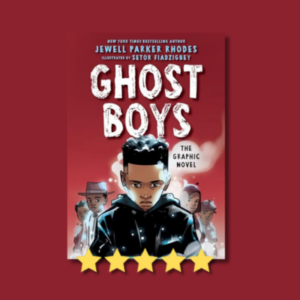
Author: Jewell Parker Rhodes Illustrator: Setor Fiadzigbey
Genres: YA Graphic Novel, Realistic Fiction, Social Justice
Audience: Grades 7–12
Number of Stars: ★★★★★ (5/5)
Goodreads Link: Ghost Boys: The Graphic Novel
Content Warnings: Gun violence, police brutality, and racism.
Publisher’s Summary
Experience Jewell Parker Rhodes’s award-winning storytelling in this tender yet visceral graphic novel adaptation of her New York Times bestselling novel, with poignant illustrations by Setor Fiadzigbey. Twelve-year-old Jerome is shot by a police officer who mistakes his toy gun for a real threat. As a ghost, he observes the devastation that is unleashed on his family and community in the wake of this unjust and brutal killing.
Soon Jerome meets another Emmett Till, a boy from a very different time but similar circumstances. Emmett helps Jerome process what has happened, on a journey toward recognizing how historical racism may have led to the events that ended his life. Jerome also meets Sarah, the daughter of the police officer who shot him, as she grapples with her father’s actions. Now gorgeously a graphic novel with gripping artwork from Black Panther illustrator Setor Fiadzigbey, Ghost Boys once again deftly explores the historical and sociopolitical layers involved in how children and families face the complexities of today’s world—and how one boy, in particular, comes to understand American Blackness in the aftermath of his own death.
Full Review
This new graphic novel adapts the story of Rhodes’ Ghost Boys (2018). The story alternates between “Dead” and “Alive” sections, providing a glimpse of Jerome’s life before tragedy struck. In the “Dead” passages, we see Jerome’s ghost witness the heart-wrenching moments when his family learns of his death, holds his funeral, and attends the hearing to determine if there is enough evidence to charge the officer.
This is an excellent tool for addressing a heavy topic. It does not shy away from the brutal reality of what happens to Jerome—clearly inspired by real-life cases like Michael Brown and Trayvon Martin. At the same time, Jerome’s connection to Sarah offers an entry point for readers who may have no personal experience with Jerome’s point of view. While a book about police brutality and prejudice could potentially spark controversy, educators should not shy away from it. The message focuses on institutional racism and unconscious bias as the real villain, rather than the individual officer.
The illustrations really pack an emotional punch. We see “Ghost Jerome” watching his parents grieve while he stands just a few feet away. We see his rage when his ghost takes on a red-hot, flaming appearance. One particularly eerie scene on page 106 shows many “ghost boys” from the past—ranging from old-fashioned to modern dress—standing outside. Along with social justice, the novel lends itself to discussions of how visual media can impact a message.
📊 Understanding the Context: Statistics & History
Police Intervention Statistics
To ground the book’s themes in data, educators can look at figures regarding police shootings and racial demographics. According to data compiled by The Washington Post and Mapping Police Violence:
- Racial Disparity: While Black Americans make up roughly 13-14% of the U.S. population, they are killed by police at a rate of approximately 31 per million, compared to 13 per million for White Americans.
- Juvenile Impact: Since 2015, over 100 children under the age of 18 have been fatally shot by police.
- Unconscious Bias: Studies in social psychology, such as the “Shooter Task,” consistently show that participants (including police officers) are faster to identify a weapon when the person holding it is Black, often misidentifying non-threatening objects (like Jerome’s toy gun) as threats.
The Legacy of Emmett Till
Jerome’s mentor in the book is Emmett Till, a real 14-year-old boy lynched in Mississippi in 1955. His death was a primary catalyst for the Civil Rights Movement.
🎒 Classroom & Curricular Connections
- ELA (Media Literacy): Discuss how the graphic novel format changes the emotional impact of the story compared to the prose novel. Analyze Setor Fiadzigbey’s use of color (e.g., the “red-hot” rage) to convey emotion.
- Social Studies (Historical Continuity): Research the history of the “Ghost Boys” mentioned in the book. Why does the author include ghosts in old-fashioned clothing?
- Ethics & SEL: Discuss the character of Sarah. How does she navigate the conflict between loving her father and recognizing his harmful actions?
- Writing Project: As suggested in the review, students can engage in a yearly reading project focusing on the evolution of civil rights and the current state of social justice.