 Published: 2025
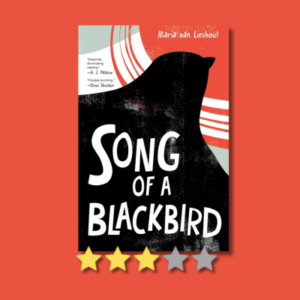
Author/Illustrator: Maria van Lieshout
Genres: YA Graphic Novel, Historical Fiction
Audience: Grades 9–12, Adult
Number of Stars: ★★★☆☆ (3/5)
Goodreads Link: Song of a Blackbird
Content Warnings: Themes of war, the Holocaust, genocide, and depictions of violence.
Publisher’s Summary
Fictionalized but based on true events, Song of a Blackbird has two intertwined timelines: one is a modern-day family drama, the other a thrilling tale of a WWII-era bank heist carried out by Dutch resistance fighters.
In the present day, teenage Annick is desperate to find a bone marrow donor that could save the life of her grandmother, Johanna. She turns to her family history and discovers a photograph taken by Emma Bergsma.
Decades earlier, Emma is a young art student about to be drawn into what will become the biggest bank heist in European history: swapping 50 Million Guilders’ worth of forged bank notes for real ones―right under the noses of the Nazis! Emma’s life―and the lives of thousands, including a young woman named Johanna―hangs in the balance.
In this stranger-than-fiction graphic novel, Maria van Lieshout weaves a tale about family, courage, and the power of art. Deeply personal yet universal, Song of a Blackbird sheds light on an untold WWII story and sends a powerful message about compassion and resistance.
Review
Song of a Blackbird tells a story of Dutch resistance to the Nazi Occupation of the Netherlands by switching back and forth between two timelines: 2011 Amsterdam and the 1940s. In 2011, Annick’s grandmother is looking for a bone marrow donor and learns that her siblings are not her biological siblings when they are tested as possible donors. This discovery leads Annick on a journey to uncover the missing parts of her grandmother’s past by investigating a series of prints her grandmother owns, but doesn’t know the origin of. As Annick locates her grandmother’s lost birth family, the full story of how Annick’s grandmother was separated from her family while she was too young to remember them is told to the reader through flashbacks following Dutch resistance fighter Emma during the Nazi occupation.
Song of a Blackbird uses multiple timelines to weave together a story about WWII that feels somewhat different than a lot of texts written for this age group. It’s a story of resistance that doesn’t really shy away from what the reality was for the Dutch resistance. Visually, it does a really great job of grounding a fictional story in the reality of the time and place that it’s set. van Lieshout does this by using actual photographs of the locations in Amsterdam as well as actual people from the Dutch resistance and illustrating the scenes from the story on top of these images. This creates an interesting visual style and also keeps the reader from forgetting that the novel is very much grounded in real events.
van Lieshout also makes an interesting narrative choice by having the novel narrated by a blackbird who follows the characters across all time periods. The bird is a narrative and visual throughline in the novel, making it an easy entry point for discussing things like narration styles and symbolism.
🐦⬛ The Symbolism of the Blackbird
The use of a blackbird as the narrator—a “witness” that spans generations—is a powerful literary device.
- The “Silent Witness”: Birds are often used in literature as symbols of freedom or objective observers who exist outside of human conflict.
- Narrative Thread: By following the characters across time, the blackbird ties the 2011 investigation of the grandmother’s medical crisis directly to the 1940s resistance struggle.
🎒 Classroom & Curricular Connections
- History (The Dutch Resistance): Unlike standard WWII narratives, this book highlights specific, localized resistance efforts (like the bank heist).
- Activity Idea: Research the Dutch Resistance (the Verzetsbeweging). What were the primary risks taken by people like Emma Bergsma?
- ELA (Narrative Perspective): Discuss the choice of a non-human narrator.
- Activity Idea: How does the blackbird’s perspective differ from a human protagonist’s? Does it make the story feel more objective or more emotional?
- Media Literacy (Mixed-Media Art):
- Activity Idea: Have students choose a historical event and “illustrate” it by finding a historical photograph of a location and adding their own sketches to it. How does the photograph change their perception of the story?
- Science (Genetics & Ancestry): Annick’s journey is sparked by a medical necessity (bone marrow donation).
- Activity Idea: Discuss how medical testing can uncover family secrets or “misattributed parentage.” What are the ethics of genetic testing for genealogy?