 Published: 2021
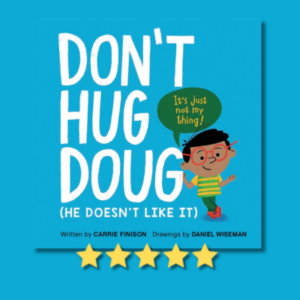
Author: Carrie Finison | Illustrator: Daniel Wiseman
Genre: Picture Book / Realistic Fiction
Audience: Pre-K–Grade 4
Number of Stars: ★★★★★ (5/5)
Goodreads Link: Don’t Hug Doug
Publisher’s Summary
Meet Doug, an ordinary kid who doesn’t like hugs, in this fun and exuberant story which aims to spark discussions about bodily autonomy and consent.
Doug doesn’t like hugs. He thinks hugs are too squeezy, too squashy, too squooshy, too smooshy. He doesn’t like hello hugs or goodbye hugs, game-winning home run hugs or dropped ice cream cone hugs, and he definitely doesn’t like birthday hugs. He’d much rather give a high five—or a low five, a side five, a double five, or a spinny five. Yup, some people love hugs; other people don’t. So how can you tell if someone likes hugs or not? There’s only one way to find out: Ask! Because everybody gets to decide for themselves whether they want a hug or not.
Review
Don’t Hug Doug is relatable to all ages! Just because Doug doesn’t like hugs, does not mean that he doesn’t like you—he does! After reading this book to my fourth-grade students, they made so many connections. It led to a valuable and deep discussion.
It opens up important conversations about personal space, consent, and respecting others’ boundaries in a way that feels fun and accessible. Doug is a friendly kid—but he doesn’t like hugs. Throughout the story, readers see how Doug interacts with others and how different people have different comfort levels with touch. The message is simple but powerful: always ask first, and respect the answer.
Fourth graders are at an age where friendships and social awareness are growing. The idea that “everyone is different” really clicks. Even though the text is simple, older students can dig deeper into why boundaries matter. It naturally supports discussions about consent, empathy, and communication. The illustrations and tone keep it light, so it doesn’t feel like a lecture.
Some fourth graders may initially think the book feels “too easy,” but that actually works in your favor—it lets them focus on the message and have more mature conversations. It’s a short, meaningful read that can spark thoughtful discussion and help build a respectful classroom community.
🧠 Core Themes: Why Boundaries Matter
- Bodily Autonomy: The fundamental right of every person to govern what happens to their own body.
- Consent: Learning to ask permission before initiating physical contact and—crucially—accepting “no” without taking it personally.
- Respecting Differences: Understanding that social norms (like hugging as a greeting) aren’t universal, and that a preference against touch is not a rejection of friendship.
🎒 Classroom & Curricular Connections
- Social-Emotional Learning (SEL): Use the book to establish classroom norms.
- Activity Idea: Practice “Consent Scripts.” Have students role-play asking, “Can I give you a high-five?” or “Would you like a hug or a wave?” and practicing the phrase, “No thank you, but I’d like a wave!”
- Health Units: Tie this into lessons about personal safety and body boundaries.
- Activity Idea: Discuss the “Stop, Ask, Respect” model. Stop and think, ask the person, and respect their answer immediately.
- Language Arts (Perspective):
- Activity Idea: Write a short journal entry from the perspective of someone who loves hugs and someone who hates them. How can both people stay friends while respecting their different needs?
- Real-Life Scenarios: * Activity Idea: Brainstorm a list of “touch-free” greetings (fist bumps, waves, air-high-fives) that students can use if they aren’t comfortable with hugs.