 Published: 2024
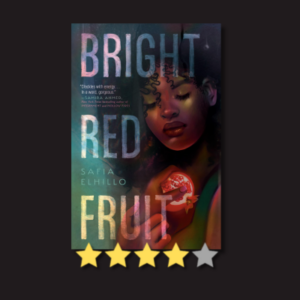
Author: Safia Elhillo
Genre: YA Novel in Verse / Contemporary Fiction
Audience: Grades 9–12, Adult
Number of Stars: ★★★★☆ (4/5)
Goodreads Link: Bright Red Fruit
Content Warnings: Inappropriate age gap, emotional abuse/grooming, and mild sexual content.
Publisher’s Summary
An unflinching, honest novel in verse about a teenager’s journey into the slam poetry scene and the dangerous new relationship that could threaten all her dreams. From the award-winning poet and author of HOME IS NOT A COUNTRY. Bad girl. No matter how hard Samira tries, she can’t shake her reputation. She’s never gotten the benefit of the doubt—not from her mother or the aunties who watch her like a hawk.
Samira is determined to have a perfect summer filled with fun parties, exploring DC, and growing as a poet—until a scandalous rumor has her grounded and unable to leave her house. When Samira turns to a poetry forum for solace, she catches the eye of an older, charismatic poet named Horus. For the first time, Samira feels wanted. But soon she’s keeping a bigger secret than ever before—one that that could prove her reputation and jeopardize her place in her community. In this gripping coming-of-age novel from the critically acclaimed author Safia Elhillo, a young woman searches to find the balance between honoring her family, her artistry, and her authentic self.
Review
Bright Red Frit is a verse novel by Safia Elhillo. The novel follows 16 year old aspiring poet Samira who lives in DC with her strict Sudanese mother. Samira struggles with her multifaceted identity. She wants to be a typical American teenager, but many of the things considered typical for an American teen are against the rules of the tight knit Sudanese community she and her mother live in. Because of this Samira is forced into a web of secrets trying to preserve her reputation in the eyes of her mother, but which ultimately makes it more difficult to ask for her mother’s help which she desperately craves as she finds herself in an abusive relationship with an inappropriate age gap.
Bright Red Fruit is beautifully written. Samira’s struggle with her personal and cultural identity, her relationship to her mother, and her relationship with predatory grown man Horus are all thoughtfully and thoroughly developed despite the brevity of much of the novel. Elhillo’s writing waves a very compelling narrative while seamlessly moving between poetry advancing the narrative, poetry written by Samira, and text reflecting all the other ways a teenager might communicate with their friends when their phone has been taken away. Because of this, the novel would function well to be studied as a whole, but it is also something that you could easily excerpt part of to use in a classroom setting. You could have students examine a particular poem or a series of poems from the novel about the same topic. There are several poems in the novel that have the same title like “Mama” or “”Horus” and you could condense a study of the novel to focus on a particular character.
🎭 Structural Analysis: The Architecture of a Verse Novel
Verse novels use poetic structures rather than traditional paragraphs to convey emotional weight and passing time. Elhillo uses specific poetic techniques to mirror Samira’s isolation and entrapment.
- The Power of White Space: The blank space on the page often represents what Samira cannot say out loud to her mother or her community, emphasizing her silence.
- Anaphora and Repeating Titles: Elhillo uses recurring poem titles like “Mama” or “Horus” throughout the book. This allows the reader to track how Samira’s perception of these two central figures shifts over time.
- Mixed Media Formatting: The inclusion of text-style spacing and forum posts illustrates the contrast between Samira’s isolated physical world and her accessible digital world.
🎒 Classroom & Curricular Connections
- English Language Arts (Poetry Analysis & Verse Structure):
- Activity Idea: “Motif Tracking.” Pull three poems titled “Mama” from the beginning, middle, and end of the book. Have students analyze how the tone, line breaks, and imagery change, tracking Samira’s evolving relationship with her mother.
- Creative Writing: Have students write a narrative poem about a time they felt caught between two different expectations (e.g., home expectations vs. peer expectations), focusing on the intentional use of line breaks to create suspense.
- Social Studies & Sociology (The Immigrant Experience):
- Activity Idea: Discuss the concept of “Hyphenated Identity” (e.g., Sudanese-American). Explore how first-generation teenagers navigate the cultural expectations of their parents’ homeland while growing up in a modern American landscape like Washington, D.C.
- Health & Guidance (Recognizing Healthy Relationships):
- Activity Idea: “Red Flags in Creative Spaces.” Horus uses his status as an established poet to charm and manipulate a teenager. Use excerpts of Horus’s dialogue to discuss the signs of emotional grooming, power imbalances, and how students can safely find mentorship in creative communities.