 Published: 2025
Author: Silvia Moreno-Garcia
Genre: Historical Fiction / Gothic Horror / Supernatural Mystery
Audience: Grade 12, Adult
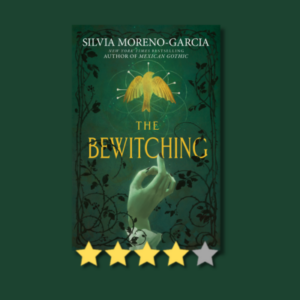
Number of Stars: ★★★★☆ (4/5)
Goodreads Link: The Bewitching
Content Warnings: Sexual assault, sexual violence, incest, grooming, death, animal abuse, violence, gore, and the occult.
Publisher’s Summary
In this chilling multigenerational horror tale, three women across different eras grapple with danger and witchcraft. Silvia Moreno-Garcia, the New York Times bestselling author of Mexican Gothic, weaves a tale where every secret uncovered brings creeping horror.
Minerva, a graduate student, delves into the life of Beatrice Tremblay, an obscure horror author, and uncovers the true story behind Tremblay’s famous novel, The Vanishing. As Minerva investigates, she feels a malevolent force that once haunted Tremblay and her roommate might still linger on campus. This force echoes a witch encounter Nana Alba, Minerva’s great-grandmother, experienced in 1900s Mexico. Minerva fears this shadow threatens her now. An academic pursuit can be challenging, but it could become deadly when witchcraft is involved.
Review
The Bewitching by Silvia Moreno-Garcia is a supernatural horror novel that is a blend of indigenous folklore, historical fiction and mystery. Moreno-Garcia tells the story of the teyolloquani, a creature that bewitches its prey before drinking their blood and ultimately killing them, using three different narrators during three different time periods. That is what I found most unique about this novel. Although initially confusing, it was interesting to see how they all intertwined and although confusing in the beginning, the relationship became clear as the story progresses.
This novel follows the research project of Minerva Contreras, a Mexican graduate student at Stoneridge College in Massachusetts in 1998. She is researching the literary work of Beatrice Tremblay, the second narrator. Beatrice was a student at the same college over 60 years earlier when one of her best friends had some strange supernatural experiences and suddenly disappeared without a trace. The further Minerva digs into the life of Beatrice and her recounting of the disappearance of her friend, she realizes there are some unsettling familiarities with some legendary tales her grandmother, Alba, told her as a child. These stories were a series of mysterious disappearances that are linked to the occult. Alba is the third narrator who tells stories of her life in rural Mexico during the early 1900’s. Eventually, it is revealed in the story that all three of characters had multigenerational experiences and struggles with a powerful evil force.
The themes explored in this novel include:
- The power of storytelling, especially passing stories from generation to generation
- Preservation of generational knowledge – so much information was lost and destroyed throughout history (this also links to the power of storytelling)
- Identity
- Family legacy
- The lasting effects of fear and trauma
- Power and privilege
- The role of women in society and how it has changed over generations
- Folklore and cultural traditions and how they shape the things we do each day in addition to our view and understanding of the world
There are curricular connections to English Language Arts with the study of gothic literature, symbolism, telling stories through multiple narratives, characterizations and exploring themes. The connections to Spanish, History and Social Studies courses include exploring Mexican folklore and superstitions, as well as cultural beliefs in witchcraft and religion. Sociology classes could study how folklore and superstitions reflect and form cultural values, fears and rituals. Students could also examine the historical role of women and their experiences throughout different eras.
Some projects students could do include:
- Creating a timeline that connects the stories of the different narrators.
- Research and present folklore from different cultures or share some from your culture.
- Compare and contrast folklore from different cultures.
- Write an additional chapter for each narrator.
- Create a movie trailer for this book.
🕸️ Narrative Structure: The Multigenerational Gothic
The primary engine of tension in The Bewitching is its nested, multi-era narrative framework. This structure mirrors the way trauma and folklore echo down a family line.
- The 1900s (Alba): Grounds the entity in Mesoamerican and Mexican folklore. This timeline establishes the raw, rural, and ritualistic origins of the evil.
- The 1930s (Beatrice): Shifts the setting to an academic, Eurocentric “Dark Academia” landscape. Here, the horror is translated into literature (The Vanishing), showing how folklore morphs into fiction.
- The 1998 (Minerva): The investigative modern lens. Minerva uses academic research to decode her own ancestral past, treating the supernatural as a puzzle to be solved before it consumes her.
🎒 Classroom & Curricular Connections
- English Language Arts (Gothic Literature & Framing):
- Activity Idea: “The Nested Timeline.” Have students create a visual timeline that maps out the overlapping events of the three narrators. Highlight where clues from Alba’s past directly explain mysteries in Beatrice’s and Minerva’s timelines.
- Creative Writing: Write an additional chapter from the perspective of one of the three narrators, ensuring the tone matches their specific historical era (e.g., matching the 1930s collegiate voice versus the 1900s oral folklore style).
- Social Studies & History (Folklore and Cultural Values):
- Activity Idea: Research the historical role of women across the three represented eras (1900s, 1930s, 1998). Discuss how the changing societal expectations of women impacted each narrator’s ability to fight back against the forces hunting them.
- Sociology & Language (Anthropology of Superstition):
- Activity Idea: “Folklore Across Borders.” Examine how indigenous Mexican folklore (such as the concept of the teyolloquani) travels, adapts, or survives when imported into a New England academic setting. Have students present a piece of folklore from their own heritage or a culture of interest, analyzing the societal fears it reflects.
- Media Literacy / Arts Integration:
- Activity Idea: Create a movie trailer storyboard or concept book trailer for The Bewitching, paying specific attention to how the visual tone changes between rural Mexico and a cold Massachusetts campus.