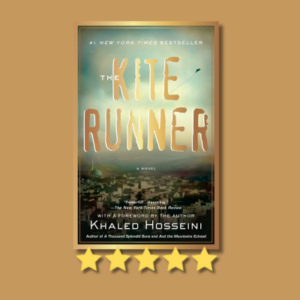
 Published: 2003 (Reprinted/Special Editions: 2013)
Author: Khaled Hosseini
Genre: Historical Fiction / Literary Fiction / Contemporary Literature
Audience: High School (Grades 11–12) / Adult
Number of Stars: ★★★★★
Goodreads Link: The Kite Runner
Content Warnings: Sexual assault/rape (including of a minor), graphic violence, war, cruel treatment of children, suicide attempts, drug/alcohol use, illness (cancer), and death.
Publisher’s Summary
The unforgettable, heartbreaking story of the unlikely friendship between a wealthy boy and the son of his father’s servant, The Kite Runner is a beautifully crafted novel set in a country that is in the process of being destroyed. It is about the power of reading, the price of betrayal, and the possibility of redemption; and an exploration of the power of fathers over sons—their love, their sacrifices, their lies. A sweeping story of family, love, and friendship told against the devastating backdrop of the history of Afghanistan over the last thirty years, The Kite Runner is an unusual and powerful novel that has become a beloved, one-of-a-kind classic.
Review
This is Hosseini’s debut novel and one that I have returned to again and again. Telling the story of two young boys, first in Afghanistan and then in the United States, this narrative is deeply moving and disturbing in many ways. It forces the reader to confront profound thematic questions: Is redemption truly possible? How much should a person interfere when witnessing violence? What is a father’s responsibility to his child? How much does a person’s traditional past dictate their future?
This book raises an incredible number of questions and allows for rich classroom discussion across many topics. Having taught this book to high school seniors for years, the feedback every single year is a resounding request to keep it on the syllabus. It provides a wonderful, humanizing window into the historical context of Afghanistan, the Islamic religion, and the complex issues immigrants face when moving to the US.
There are some exceptionally tough subjects in the text, which has unfortunately led to this book being frequently banned and/or challenged in many communities. While readers must absolutely be prepared for these sensitive and heavy topics, the overall emotional and educational impact of the story far outweighs the discomfort of the context. The author has served as a UN Human Rights ambassador and continues to fight for global human rights. Though he has written other celebrated books, this debut novel is still the one that resonates with me and my students year after year.
🗺️ The Geopolitical and Social Landscapes of Afghanistan
To fully comprehend Amir’s guilt and eventual journey toward redemption, students must understand the deep ethnic, religious, and political shifts that overrode Afghanistan during the late 20th century.
- The Ethnic Divide (Pashtun vs. Hazara): The tragic dynamic between Amir and Hassan is rooted in Afghanistan’s strict social hierarchy. Amir is a Sunni Muslim and an ethnic Pashtun (the ruling, privileged majority). Hassan is a Shia Muslim and an ethnic Hazara (a severely persecuted minority group). This systemic power imbalance directly fuels Amir’s childhood entitlement and his paralyzing inaction during Hassan’s assault.
- The Structural Evolution of a Nation: Hosseini uses the setting to mirror Amir’s internal state. Pre-war Kabul is vibrant, artistic, and full of kite-flying; the Soviet invasion brings fractured displacement; and the subsequent Taliban regime represents a bleak, totalitarian landscape where the ghosts of Amir’s past must finally be confronted.
🎒 Classroom & Curricular Connections
- Social Studies & World History (The Middle East & Immigration):
- Activity Idea: “Mapping the Diaspora.” Track Amir and Baba’s flight from Kabul through Pakistan to Fremont, California. Research the cultural adjustments, economic shifts (from wealth to working gas stations), and psychological challenges faced by Afghan refugees arriving in the US during the 1980s.
- English Language Arts (The Archetype of Redemption):
- Activity Idea: “The Motif of the Kite.” Kites serve as a multi-layered symbol throughout the novel. Analyze how the kite represents freedom, a desperate desire for parental approval, betrayal, and eventually, healing. Have students write an analytical paragraph tracing the symbol’s evolution across the text.
- Socratic Seminar (Ethics and Responsibility):
- Activity Idea: Conduct a classroom debate exploring Baba’s famous quote: “There is only one sin, only one. And that is theft. Every other sin is a variation of theft.” Challenge students to evaluate Amir’s actions through this moral framework—what did Amir “steal” from Hassan? What did Baba steal from Amir?
- Media Literacy & Defense Against Censorship:
- Activity Idea: “The Banned Book Argument.” Given that this novel is frequently challenged, have students read a real-world case study of a school board challenge against The Kite Runner. Students can write a persuasive defense letter arguing why the literary value and human rights context of the novel merit its preservation in high school curriculums.