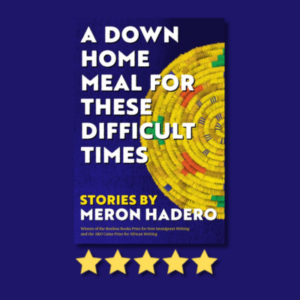
 Published: 2022
Author: Meron Hadero
Genre: Short Story Collection / Literary Fiction / Diaspora Literature
Audience: Grades 11–12 (Advanced High School) & Adults
Number of Stars: ★★★★☆ (3/4 or ~4/5) (Note: The original text marks 3/4 stars in its metadata rating but 5-star in the blog headline).
Goodreads Link: A Down Home Meal for These Difficult Times
Content/Trigger Warnings: War, death, human trafficking, systemic racism, hate crimes, and racial slurs.
Diversity: Explicitly centers Black, immigrant, and refugee voices, bridging the lived experiences of the Ethiopian diaspora with Black American narratives.
Review by: Sarah Williams
Publisher’s Summary
Set across the U.S. and abroad, Meron Hadero’s stories feature immigrants, refugees, and those on the brink of dispossession, all struggling to begin again, all fighting to belong. Moving through diverse geographies and styles, this captivating collection follows characters on the journey toward home, which they dream of, create and redefine, lose and find and make their own. Beyond migration, these stories examine themes of race, gender, class, friendship and betrayal, the despair of loss and the enduring resilience of hope.
Winner of the 2021 AKO Caine Prize for African Writing, “The Street Sweep” is about an enterprising young man on the verge of losing his home in Addis Ababa who pursues an improbable opportunity to turn his life around. Appearing in Best American Short Stories, “The Suitcase” follows a woman visiting her country of origin for the first time and finds that an ordinary object opens up an unexpected, complex bridge between worlds. Shortlisted for the 2019 Caine Prize, “The Wall” portrays the intergenerational friendship between two refugees living in Iowa who have connections to Germany before the fall of the Berlin Wall. A Best American Short Stories notable, “Mekonnen aka Mack aka Huey Freakin’ Newton” is a coming-of-age tale about an Ethiopian immigrant in Brooklyn encountering nuances of race in his new country.
Kaleidoscopic, powerful, and illuminative, the stories in A Down Home Meal for These Difficult Times expand our understanding of the essential and universal need for connection and the vital refuge of home—and announce a major new talent in Meron Hadero.
Review
Meron Hadero’s award-winning debut collection, A Down Home Meal for These Difficult Times, is a stunning literary achievement that not only satisfies the palate but also offers a beautiful escape into the heart of family, tradition, and human resilience. In this collection, Hadero masterfully weaves together narratives that celebrate the unique power of food to heal and bring people together, especially during life’s most challenging moments.
Hadero fluidly moves her narratives between the United States and Ethiopia, telling vital stories that involve refugees and immigrants as well as Black people in America. These stories are deeply important not only for their rich connection to food, but also for how they directly intersect with pressing contemporary topics.
The individual stories are filled with diverse, beautifully rendered characters, each possessing their own unique backgrounds and experiences, yet universally connected by the common thread of a shared meal. Food is an element we can all fundamentally relate to, and most of us can deeply understand the comfort of eating a meal with those we love.
One of the greatest strengths of Hadero’s storytelling lies in the absolute authenticity and emotional warmth of each tale. The characters are completely relatable, their personal struggles feel genuine, and their triumphs are heartwarming. As readers journey through these pages, they are invited directly into the kitchens and dining rooms of these characters, where food transforms into a profound source of solace, connection, and hope.
This concept carries an especially important weight given the recent global pandemic. The book was published during an era when preparing and eating meals at home became not only important but absolutely essential for survival, making the idea of a family unit—regardless of how that unit looks—gathering together around a table feel even more poignant. I truly enjoyed this book because the prose is incredibly rich, clearly showcasing Hadero’s deep appreciation for the many distinct culinary traditions that bind families and communities together.
🌍 The Geography of Dispossession and Comfort
Hadero uses the preparation of food as a structural anchor, allowing characters navigating global migration to retain their history while building new lives in unfamiliar landscapes.
- Food as Cultural Literacy: For a refugee, a traditional recipe is a portable archive. When characters are stripped of their homes, legal status, or financial security, reproducing a meal from their homeland becomes a radical act of preservation and psychological survival.
- The Chronotope of the Pandemic Table: As the reviewer notes, publishing these stories in the wake of global lockdowns highlighted the domestic table as a sanctuary. Food ceases to be simple nutrition; it becomes a focal point for processing collective isolation and grief.
🎒 Classroom & Curricular Connections
- English Language Arts & Creative Writing (The Food-Centric Narrative):
- Activity Idea: “The Memory Recipe.” Have students read the title story of Hadero’s collection. Discuss how she uses the sensory details of cooking (smells, spices, temperatures) to trigger deeper character memories of home and displacement. Have students select a meal or ingredient that represents a tradition in their own family, writing a short personal narrative or poem exploring the emotional memories tied to that dish.
- Human Geography & Sociology (Analyzing Refugee Movements and Demographics):
- Activity Idea: “Mapping the East African Diaspora.” Use the book to introduce the history of modern migration from East Africa to the United States. Ground the text’s fictional struggles in actual global demographics to build a complete analytical perspective.
- U.S. East African Migration Context: Over the last several decades, the Ethiopian diaspora in the United States has grown significantly. According to data from the Migration Policy Institute, there are approximately 300,000 to 500,000 individuals of Ethiopian origin residing in the U.S., making it the second-largest African immigrant group in the country. Major urban centers like Washington, D.C., Minneapolis, and Seattle serve as primary cultural hubs where culinary traditions, community networks, and cultural preservation act as vital safety nets for newly arrived refugees navigating social and economic integration. Have students track these migration pathways, creating a research brief on how refugee resettlement organizations support families as they transition into these American diaspora hubs.
- Media Literacy & Ethics (Deconstructing Stereotypes of Migration):
- Activity Idea: “The Humanizing Narrative.” Contrast mainstream news headlines about global refugee crises with the intimate, internal character studies found in Hadero’s fiction. Have students write a comparative essay analyzing how literary fiction fills in the emotional gaps left behind by clinical news statistics, discussing how storytelling builds empathy across different cultural lines.