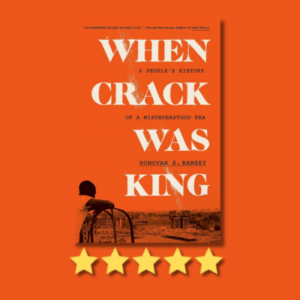
 Published: 2023
Series: N/A
Author: Donovan X. Ramsey
Illustrator: N/A
Genres: Nonfiction, History, Politics, Race, True Crime, Crime, American History, Social Justice, Drugs
Audience (Grade Levels): High School (Grades 11-12)
Number of Stars: ⭐⭐⭐⭐⭐
Goodreads Link: When Crack Was King
Triggers: Sexual assault; racism; violence, including police brutality; descriptions of drug use
Review By: Evan Waugh
Publisher’s Summary:
“The crack epidemic of the 1980s and 1990s is arguably the least examined crisis in American history. Beginning with the myths inspired by Reagan’s war on drugs, journalist Donovan X. Ramsey’s exacting analysis traces the path from the last triumphs of the Civil Rights Movement to the devastating realities we live with today: a racist criminal justice system, continued mass incarceration and gentrification, and increased police brutality.
When Crack Was King follows four individuals to give us a startling portrait of crack’s destruction and devastating legacy: Elgin Swift, an archetype of American industry and ambition and the son of a crack-addicted father who turned their home into a “crack house”; Lennie Woodley, a former crack addict and sex worker; Kurt Schmoke, the longtime mayor of Baltimore and an early advocate of decriminalization; and Shawn McCray, community activist, basketball prodigy, and a founding member of the Zoo Crew, Newark’s most legendary group of drug traffickers.
Weaving together riveting research with the voices of survivors, When Crack Was King is a crucial reevaluation of the era and a powerful argument for providing historically violated communities with the resources they deserve.” (Amazon.com)
Review:
In this work of nonfiction, journalist Donovan X. Ramsey charts the trajectory of the crack-cocaine epidemic, which began in the 60s and continued into the 90s. In presenting this history, Ramsey frames his narrative through the stories of four individuals who lived through the crack epidemic: Elgin Swift, the son of a crack user; Lennie Woodley, a former crack user; Kurt Schmoke, the first publicly-elected mayor of Baltimore, whose tenure took place during the height of the crack epidemic; and Shawn McCray, a crack dealer who operated in Newark, New Jersey. In presenting these four disparate first-hand accounts, Ramsey puts a human face on a misunderstood time in American history that was indeed deadly, traumatic, politicized, and even – as Ramsey goes so far as to suggest – ostensibly manufactured by the United States government.
There was a lot that I learned reading this text, both about Crack-Cocaine as a drug, but also how it was weaponized to police minority communities through the 70s and 80s, beginning with Reagan and Nixon’s War on Drugs, and continuing through to Bill Clinton’s – backed by current President Joe Biden – tough-on-crime laws in the 90s. Ramsey does a great job of writing objectively about these moments in history, but there are times where I applaud him for dropping the guise of traditional reporting and calling a spade a spade, meaning confronting America’s racist history and referring to it as such. This is a book that would definitely be better suited for secondary-level students (for obvious reasons, as well as for more sensitive subject matter within each page), but I hope that this book might some day receive the Jason Reynolds treatment and be adapted for young readers, much in the same way that Ibram X. Kendi’s Stamped received such treatment. When Crack Was King is an important text that should be visited by everyone, even those who want to tackle individual chapters. I hope to read more from Donovan X. Ramsey in the future.
Classroom & Curricular Connections:
- Social Studies & United States History: This text functions as an extraordinary tool for upper-level secondary students to analyze late 20th-century political history, the War on Drugs policy platform, the impacts of legislative acts throughout the Nixon, Reagan, and Clinton administrations, and the structural history of modern American policing.
- Social Justice & Sociology: Highly useful for units exploring institutionalized racism, the social mechanics behind mass incarceration, community gentrification, and the complex socioeconomic realities that historically targeted and impacted urban minority communities.
- Extension Activity / Library Application:
- High School Research Seminar & Document Analysis: Educators can assign individual chapters focusing on one of the four personal narratives. Students can pair the selected chapter with period-specific news archives or primary-source government documents from the 1980s and 1990s to compare public media framing against actual survivor realities.
- Library Resource for Independent Nonfiction Reading: Feature this text during Black History Month, social justice book club campaigns, or alongside curriculum resources addressing contemporary systemic inequalities.
- Diversity & Representation: This text serves as a crucial work of OwnVoices historical journalism, centering Black perspectives and the direct voices of survivors from historically violated communities. By framing historical analysis through diverse first-hand backgrounds—ranging from an activist and a former sex worker to an elected city mayor and a former drug trafficker—Ramsey avoids generalized stereotypes and provides humanizing, nuanced representation of community trauma and ultimate resilience.
Readalikes:
- Stamped: Racism, Antiracism, and You by Jason Reynolds and Ibram X. Kendi
- The New Jim Crow: Mass Incarceration in the Age of Colorblindness by Michelle Alexander