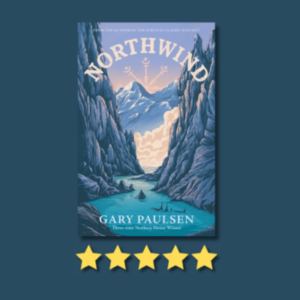
 Published: 2022
Series: N/A
Author: Gary Paulsen
Illustrator: N/A
Genres: Middle Grade, Adventure, Historical Fiction, Fiction, Young Adult, Survival, Audiobook, Historical, Juvenile, Children’s Fiction
Audience (Grade Levels): Grades 4-8
Number of Stars: ⭐⭐⭐⭐⭐
Goodreads Link: Northwind
Triggers / Content Warnings: Deadly plague/illness, death of secondary characters, raw survival elements, and animal attacks.
Review By: Kim LeRoy
Publisher’s Summary:
The story of a young person’s battle to stay alive against the odds, where the high seas meet a coastal wilderness. When a deadly plague reaches the small fish camp where he lives, an orphan named Leif is forced to take to the water in a cedar canoe. He flees northward, following a wild, fjord-riven shore, navigating from one danger to the next, unsure of his destination. Yet the deeper into his journey he paddles, the closer he comes to his truest self as he connects to “the heartbeat of the ocean . . . the pulse of the sea.” With hints of Nordic mythology and an irresistible narrative pull, Northwind is Gary Paulsen at his captivating, adventuresome best.
Review:
This book is about a boy Leif, about 12 years old who finds himself alone and must survive with just his canoe, a blanket and a few tools. It is Norway in an earlier time and he is going north into the inlets and fjords. It is about survival and learning about the world on his own. Gary Paulsen uses all his senses in the descriptions to such a degree that you can smell, taste, feel, touch and hear what he describes. It is compared to Hatchet but on water, but as I recall, Hatchet was much more down-to-earth with details a reader could imagine. I’m really not sure whether an average grade 4-6 student would sit through the first few confusing chapters of this journey. Northwind was much more mystical and the descriptions of coves and islands became so repetitive, I began to skim the sections between the few vivid action scenes. I kept expecting something different to happen and I think some of my students would struggle to get through the entire book. I’m not sure this is geared towards the right audience.
Although there are delightful descriptions of whale and bird encounters, sometimes things get pretty gritty. Survival is not pretty, but it does bring joy and hope for better days. In general I found this narrative a bit disappointing and the abrupt ending left little direction for what was to come. Somehow a life paddling through the fjords of Norway does not do it for me even though the writing itself was amazing and descriptive.
Classroom & Curricular Connections:
- ELA (English Language Arts): An excellent mentor text for teaching sensory imagery, analyzing survival-archetype motifs, comparing internal versus external conflict, and examining how an author uses non-linear, meditative structures to convey isolation.
- Science & Environmental Studies: Integrates beautifully with middle-school science modules investigating marine life ecosystems, the geographical formation of fjords, glacial topography, and the migratory behavior of whales and sea birds.
- SEL (Social-Emotional Learning): Provides great entry points for discussing self-actualization, coping with intense grief and isolation, finding inner courage when facing overwhelming odds, and fostering deep mindfulness through connections with the natural world.
- Extension Activity / Library Application: Perfect for use as an interactive school library application or media center choiceboard option. Utilizing the marine geography featured in Leif’s journey, educators can run a “Fjord Ecosystem & Navigation Challenge.” Students can research the real-world climate, flora, and fauna of Northern Norway’s coastline, designing a illustrated survival map or digital presentation detailing how an individual can source clean water, build shelter, and identify edible resources along a subarctic maritime biome.
- Diversity & Representation: The novel supports diversity, equity, and inclusion by broadening traditional Western survival narratives to focus on historical Nordic environments and the often-overlooked perspective of a displaced, orphaned protagonist. By exploring an ancient, non-industrialized way of living that respects natural boundaries and cross-species ecosystem harmony, the book challenges anthropocentric biases and offers a unique literary mirror for young readers analyzing human intersectionality within historical global cultures.
Readalikes:
- A Wolf Called Wander by Rosanne Parry
- Summer of the Monkeys by Wilson Rawls
- Julie of the Wolves by Jean Craighead George
- My Side of the Mountain by Jean Craighead George