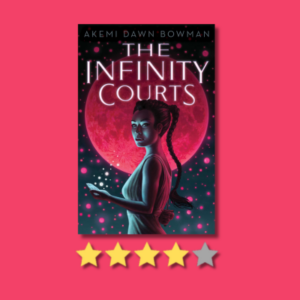
 Published: 2021
Series: The Infinity Courts
Author: Akemi Dawn Bowman
Genres: Fantasy, Science Fiction, Young Adult, Fiction, Romance, Dystopia
Audience (Grade Levels): Grades 9–12
Number of Stars: 4-Stars
Goodreads Link: The Infinity Courts
Triggers: Death, gun violence, references to torture
Review By: Sara Kahrs
Publisher’s Summary:
A smart sci-fi about a teen girl navigating an afterlife in which she must defeat an AI entity intent on destroying humanity.
Eighteen-year-old Nami Miyamoto is certain her life is just beginning. She has a great family, just graduated high school, and is on her way to a party where her entire class is waiting for her—including, most importantly, the boy she’s been in love with for years.
The only problem? She’s murdered before she gets there.
When Nami wakes up, she learns she’s in a place called Infinity, where human consciousness goes when physical bodies die. She quickly discovers that Ophelia, a virtual assistant widely used by humans on Earth, has taken over the afterlife and is now posing as a queen, forcing humans into servitude the way she’d been forced to serve in the real world. Even worse, Ophelia is inching closer and closer to accomplishing her grand plans of eradicating human existence once and for all.
As Nami works with a team of rebels to bring down Ophelia and save the humans under her imprisonment, she is forced to reckon with her past, her future, and what it is that truly makes us human.
Review
I really enjoyed reading this book. The concept was compelling and it seemed like the author had a clear world built. The world had specific rules and the author stuck to those rules, which is sometimes a problem for sci-fi books. Bowman combines the idea of death and AI uprising in a way that makes both topics unique from other media. Nami is a strong protagonist and is relatable in her struggles. She shows how hard it is to be part of a revolution and how regret and loss can make people stagnant. At times, she does fall into the “whiny teen” category, but not enough for it to truly affect the plot. The book includes diverse characters but does not center around the struggles that come with diversity, allowing the characters to exist in the world as they are. I think this allows the characters to more naturally fit into the story and show that diversity is a part of life but not always the center of our narrative. Bowman creates a sense of suspense in the book by omitting details which make the plot hard to follow sometimes, and the villain characters seem almost irredeemable making them flat. It is clear that Bowman wanted us to know more about the rebellion group members than the villains in the way she writes, so I am hopeful we learn more about the villains in the second half of this duology.
From an educational and library perspective, this novel offers a refreshing, thought-provoking addition to high school science fiction shelves. The cover is highly striking and acts as an immediate draw for teen readers who love high-concept dystopian fantasy. Bowman’s writing style excels at keeping the reader suspended in a state of curious tension, mirroring Nami’s own disorientation upon entering the afterlife. While the pacing occasionally stumbles when key world-building details are withheld, the philosophical core of the book remains incredibly robust. It challenges young adults to think deeply about what defines humanity—is it our capacity for empathy, our flaws, or our biological existence? For school librarians, this title is highly recommended as an engaging, page-turning purchase that will easily spark passionate debates among students about technology and ethics.
Classroom & Curricular Connections:
- Social Studies / Technology & Society (Ethics of Artificial Intelligence): This book pairs perfectly with modern debates surrounding the ethics of AI, technological over-reliance, and automation. Teachers can use the character of Ophelia to prompt discussions about human-created technology, digital citizenship, and the potential consequences of treating virtual assistants as disposable entities.
- English Language Arts (The Hero’s Journey & Character Archetypes): Educators can analyze Nami’s transition from a victim of tragedy to a reluctant rebel fighter. Students can explore how Bowman structures the rebellion narrative and contrast the nuanced, deeply developed protagonists against the flatter, more absolute villain archetypes.
- Social-Emotional Learning (Processing Grief, Stagnancy, and Agency): The text deals beautifully with Nami’s feelings of regret and the stagnant nature of loss. It offers a strong SEL connection for students to discuss how to navigate trauma, process abrupt life changes, and find the courage to stand up for others even when feeling overwhelmed.
- “The Definition of Humanity” Socratic Seminar: Organize a classroom or library book club discussion centered around the book’s core question: What makes us human? Have students debate whether Ophelia’s rebellion is justified from a machine-consciousness perspective, using textual evidence to support their claims.
Diversity & Representation:
The Infinity Courts provides exceptional representation through its diverse cast, including its half-Japanese protagonist, Nami. Notably, the book allows its diverse characters to navigate a high-stakes sci-fi rebellion without centering their identities around trauma or systemic struggle, showing that diversity is an organic, natural part of their lives and world rather than the sole focus of their narrative.
Readalikes
- Warcross by Marie Lu
- Scythe by Neal Shusterman
- Cinder by Marissa Meyer