 Published: 2020
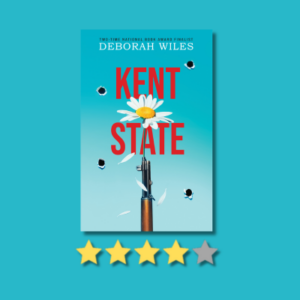
Author: Deborah Wiles
Genres: Historical Fiction, Young Adult, Poetry, Novel in Verse, War, Politics
Audience (Grade Levels): Grades 7-12
Number of Stars: 4-Stars
Goodreads Link: Kent State
Triggers: Violence, gun violence, death, and historical trauma
Review By: Karen Fenner
Publisher’s Summary
An exploration of one of the darkest moments in our history, when American troops killed four American students protesting the Vietnam War. May 4, 1970. Kent State University. As protestors roil the campus, National Guardsmen are called in. In the chaos of what happens next, shots are fired and four students are killed. To this day, there is still argument of what happened and why. Told in multiple voices from a number of vantage points—protestor, Guardsman, townie, student.
Review
This free verse novel’s power comes from the perspectives of the various voices who recount the days leading up to the killing of four students on the Kent State campus during the Vietnam War. Despite the fact that students were shot on their own college campus, a place where parents thought they were safe, the accounts of the events leading up to the shootings are disparate and each of the voices believes that they have the correct facts. While some students may find the text confusing, the voices are differentiated by different fonts, and the award-winning audio version of the novel, available on Sora, could help clarify the speakers. A prelude provides helpful historical information on the events recounted in the book and back notes provide information on the author’s research. I was struck when reading this by the extent to which the different perspectives that are voiced in the book about the events at Kent State mirror some of the social and political polarization we are experiencing today. The brilliant structure of the novel works well for teaching perspective, point of view, and bias – important skills in today’s world. An exploration of one of the darkest moments in our history, when American troops killed four American students protesting the Vietnam War.
Classroom & Curricular Connections
- Social Studies / History: This novel is a prime resource for studying the Vietnam War era, domestic protests, and the political climate of the late 1960s and early 1970s.
- ELA / Literary Analysis: The book is an excellent tool for teaching poetic forms (novel in verse), narrative perspective, author’s craft, and examining bias and point of view through differing historical recollections.
- Primary Source Analysis: Pair the reading of this novel with a primary source analysis activity. Students can read transcripts, view historical photos, or listen to audio recordings from May 4, 1970, to cross-reference the perspectives presented by Wiles with historical documentation. Utilizing the audio version on Sora can also serve as a group listening exercise to map out different narrative threads.
Readalikes:
- All the Broken Pieces by Ann E. Burg
- Kent State: Four Dead in Ohio by Derf Backderf
- All American Boys by Jason Reynolds and Brendan Kiely
- Violent Ends by Brendan Shusterman, Neal Shusterman, and Shaun David Hutchinson
- Revolution by Deborah Wiles