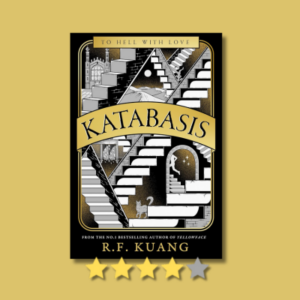
 Published: 2025
Genres: Dark Academia, Mythology, Fantasy, New Adult
Audience: Grades 10–12, Adult (Mature 8+)
Number of Stars: ★★★★☆ (4/5)
Goodreads Link: Katabasis
Content Warnings: Abuse of power, animal death, blood, death, gore, grief, manipulation, grooming, mention of suicide, misogyny, and murder.
Publisher’s Summary
Dante’s Inferno meets Susanna Clarke’s Piranesi in this dark academia fantasy from R. F. Kuang. Alice Law has only ever had one goal: to become one of the brightest minds in the field of Magick. She has sacrificed everything—her pride, her health, and her sanity—to work with Professor Jacob Grimes at Cambridge. That is, until he dies in a magical accident that could possibly be her fault.
Grimes is now in Hell, and she’s going in after him. His recommendation holds her entire future in his now-incorporeal hands, and even death will not stop her. But she isn’t alone; her rival, Peter Murdoch, has come to the same conclusion. With nothing but the tales of Orpheus and Dante to guide them, and enough chalk to draw the pentagrams necessary for their spells, they set off across Hell to save a man they don’t even like.
Review
Alice made a mistake… and she’ll do anything—including going to mythological hell—to fix it. She sets off on a perilous journey in which Alice, and fellow classmate Peter, go through the physical manifestation of Dante’s Inferno in order to rescue their teacher and mentor Dr. Grimes. These two don’t always get along and much of the story’s tension comes from their struggle to overcome internal and external obstacles.
From page one the reader is dropped into the action (the exposition or “info-dumping” comes later) and tension runs high throughout the book. The character’s only weapons in this otherwise alien world are pieces of chalk and the knowledge of runes that can be used to create magic. The depictions of gore and death in this book aren’t overly graphic or gratuitous. Instead, they ground the story solidly in a place devoid of hope but fueled by grim determination.
At times the narrative pacing felt slow and it wasn’t one that I “couldn’t put down.” This appears to be a deliberate choice by the author who may have been trying to emphasize that “hell” is boring and monotonous, which is why it should be all the more terrifying. The story also includes consistent flashbacks where we get a deeper understanding of both protagonists to a satisfactory degree. These memories become important as we move toward the climax and realize that the character’s journeys and motives may not be as clear-cut as we may have first believed.
This book is solidly in the high school range (maybe an extremely mature 7th or 8th grader). I would consider it more New Adult than Adult because some of the themes are heavy-handed and there is a lack of ambiguity when dealing with a subject that could have benefited from more open-ended questions or ideas.
🏛️ Dark Academia & The “Katabasis”
The title itself, Katabasis, refers to a “descent into the underworld.” In R.F. Kuang’s hands, this isn’t just a physical journey, but a metaphorical exploration of Academic Trauma. The characters are literally willing to go to Hell because their self-worth is so tied to the approval of a powerful mentor.
🖍️ The Magic System: Runes and Chalk
Unlike “soft” magic systems where power is innate, Kuang uses a “hard” system based on academic knowledge.
| Weapon | Usage in the Underworld |
| Chalk | The physical medium for channeling intent. |
| Runes | Geometric/linguistic symbols that require precision and study. |
| Academic Lore | Knowledge of Orpheus and Dante acts as a “map.” |
🎒 Curricular Connections
- World Mythology & Literature: This is a perfect companion for students reading Dante’s Inferno or the Orpheus myth. It modernizes the “Katabasis” trope and invites students to compare how different eras visualize the afterlife.
- Ethics & Power Dynamics: The relationship between Dr. Grimes and his students opens discussions on mentorship vs. exploitation. Alice’s willingness to risk her soul for a recommendation letter is a stark look at high-pressure academic environments.
- Visual Thinking: Students could map the physical manifestation of Hell in the book versus Dante’s circles.