 Review By: Anonymous
Published: 2025
Genres: Historical Fiction, Thriller, Mystery, Horror
Audience: Grades 11, 12, Adult
Number of Stars: ★★★☆☆ (3/5)
Goodreads Link: The Mad Wife
Content Warnings: Mental health struggles, pregnancy and child loss, medical trauma, and domestic issues.
Publisher’s Summary
They called it hysteria. She called it survival.
Lulu Mayfield has spent the last five years molding herself into the perfect 1950s housewife. Despite the tragic memories that haunt her and the weight of exhausting expectations, she keeps her husband happy, her household running, and her gelatin salads the talk of the neighborhood. But after she gives birth to her second child, Lulu’s carefully crafted life begins to unravel.
When a new neighbor, Bitsy, moves in, Lulu suspects that something darker lurks behind the woman’s constant smile. As her fixation on Bitsy deepens, Lulu is drawn into a web of unsettling truths that threaten to expose the cracks in her own life. The more she uncovers about Bitsy, the more she questions everything she thought she knew—and soon, others begin questioning her sanity. But is Lulu truly losing her mind? Or is she on the verge of discovering a reality too terrifying to accept?
Review
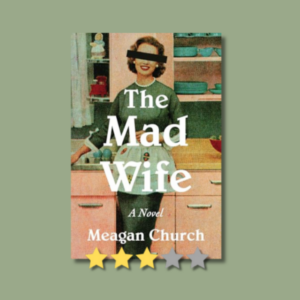
Meagan Church’s The Mad Wife is a dark and intense look at the “perfect” life of a 1950s housewife. I’d definitely recommend it to adults who like psychological stories where you aren’t quite sure what is real. It’s a great pick for a book club because there is so much to talk about, but I really don’t think it would interest teens. Even though the vintage cover looks cool, the plot moves slowly and focuses on things like mid-century housework and mental health struggles that younger readers would probably find boring or unrelatable. There are no pictures inside, so you really have to rely on the writing to see the world Lulu is trapped in.
The main themes are medical gaslighting and the pressure to be a perfect mother. It shows how doctors back then often dismissed women’s feelings or used scary “cures” to keep them quiet. For a school connection, it would be great for a history or sociology class looking at how women were treated in the past. A fun activity could be looking up old magazine ads from the 50s and comparing those happy images to the messy reality Lulu lives in the book. While the story is about a specific group of people, it adds diversity to the shelf by being so open about maternal mental health—a topic people used to keep secret. If you liked Church’s other book, The Last Girls of Orchard House, you’ll enjoy how she shows the dark side of history again here. It’s a sad and heavy read, but it’s really hard to put down once you get into Lulu’s head.
🎙️ The Dark Side of the “Happy Housewife”
The 1950s are often depicted as a golden age of domestic bliss, but The Mad Wife peels back that wallpaper to reveal a much grimmer reality. Central to Lulu’s struggle is the concept of Medical Gaslighting—a term used when healthcare providers dismiss a patient’s symptoms or attribute them to psychological factors rather than physical ones.
🩺 Historical Context: Hysteria & The “Rest Cure”
For centuries, women’s emotional and physical distress was often categorized under the blanket term “hysteria.”
| Concept | The 1950s Narrative | The Reality for Lulu |
| Motherhood | Natural, effortless, and fulfilling. | Exhausting, isolating, and fraught with grief. |
| Medical Treatment | Doctors are the ultimate authority. | Doctors dismiss pain and use sedatives to quiet dissent. |
| Social Expectation | Perfection is the standard for the home. | The “perfect” home is a cage that masks mental decline. |
📝 Curricular & Classroom Connections
- Sociology / History (Women’s Rights): This book is an excellent primary-source-adjacent tool for discussing the “feminine mystique.” Students can analyze the shift from the Rosie the Riveter era of WWII back to the rigid domesticity of the 50s.
- Media Literacy Activity: Have students find 1950s magazine ads for household products (cleaning supplies, kitchen appliances). Discuss how these ads sold a “dream” that intentionally ignored the mental health realities of the women they targeted.
- Psychology: Explore the theme of Postpartum Depression and how it was treated (or ignored) historically compared to modern medical standards.