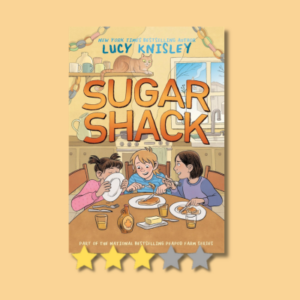
 Series: Peapod Farm, Book 3
Published: 2025
Author/Illustrator: Lucy Knisley
Genres: Middle Grade Graphic Novel, Fiction, Family
Audience: Grades 3–7
Number of Stars: ★★★☆☆ (3/5)
Goodreads Link: Sugar Shack
Publisher’s Summary
Like the seasons, everything changes with time, and for one city-kid turned country girl, she’s ready to settle in for the winter…too bad there is always work to be done! Don’t miss out on the final volume of New York Times bestselling author Lucy Knisley’s Peapod Farm series!
Winter has come to Peapod Farm and Jen couldn’t be more excited to spend time with her step-sisters. Jen has been so focused on trying to figure out how she fits into her new family that she hasn’t realized she’s found her place until Reese calls her ‘sister’.
Unfortunately, this puts a rift between Jen and Andy. Andy has been and will always be Reese’s ACTUAL sister, Jen is just the STEP sister. Just when Jen thought she had everything figured out she’s suddenly not so sure…Jen still has a lot to learn about living life outside the city!
Maybe between Peapod Farm’s first snow and learning how to tap a tree for sugar, Jen and Andy both will have a chance to truly understand what it means to be family.
Review
Lucy Knisley’s third book in the Peapod Farm graphic novel series, Sugar Shack, follows Jen and her family’s continued adventures of farm life and navigating the dynamics of a blended family. This installment concentrates heavily on outdoor farm life and the process of harvesting maple sugar. Jen is the central character, and the story follows her as she joins 4H, meets new people, and leans more into drawing as a creative outlet. Meanwhile, Andy prepares for her bat mitzvah and Reese discovers a new love of cooking.
We also learn a little more about Jen’s mother and the various jobs she held before falling in love with farming. Jen continues to clash with Walter, who wishes she dressed more like a “typical girl” rather than the comfortable, tomboyish clothes she prefers. A significant portion of the book is also dedicated to the detailed process of maple syruping and the time and effort it requires.
Sugar Shack is an enjoyable read and would be a perfect fit for upper elementary and middle-grade readers. The themes of family dynamics and shifting friendships feel contemporary and relatable. I really enjoyed the illustrations and felt they portrayed the characters and events in a detailed and expressive way that added depth to the story. This was the first book in the series I had read, so I was initially confused by the family dynamic (a little outside research helped clear that up). It can, however, be read as a standalone. Personally, I found the story lacking a bit in substance. It was a pleasant and cozy read, but overall felt a little on the bland side.
🌲 The Science of Maple Syruping
A major educational component of this book is the step-by-step process of turning tree sap into syrup.
- Tapping: In late winter when temperatures fluctuate above and below freezing, sugar maples are tapped.
- The Ratio: It takes roughly 40 gallons of sap to produce just one gallon of maple syrup. This explains why the process requires so much time and effort!
- Evaporation: The sap is boiled in an “evaporator” to remove the water content until it reaches the correct sugar concentration.
🎒 Classroom & Curricular Connections
- Science (Seasonal Cycles): Use the book to discuss why sap flows in the late winter/early spring.
- Activity Idea: Research the “Freeze-Thaw” cycle of maple trees. Why is this specific temperature fluctuation necessary for the sap to run?
- SEL (Blended Families): The book addresses the common tension of “step-siblings” vs. “biological siblings.”
- Activity Idea: Facilitate a discussion on family identity. How do we define “sisterhood” or “brotherhood”? Is it defined by biology or by shared experiences?
- ELA (Visual Storytelling): Analyze how Knisley uses her illustrations to show character growth.
- Activity Idea: Focus on Jen’s character development through her clothing and her art. How do these visual cues show her independence and her journey toward self-acceptance?
- Life Skills (4-H & Farming):
- Activity Idea: Explore what 4-H is. Why do people join these clubs? Have students brainstorm a list of skills they would want to learn if they were in a 4-H club.