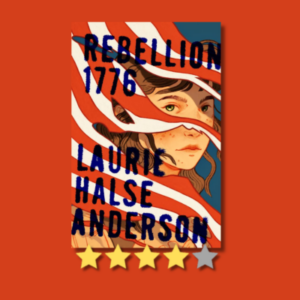
 Published: 2025
Author: Laurie Halse Anderson
Genre: Historical Fiction / Middle Grade
Audience: Grades 5–9
Number of Stars: ★★★★☆ (4/5)
Goodreads Link: Rebellion 1776
Themes: Survival, American Revolution, Medical History, Gender Roles, Perseverance.
Publisher’s Summary
A historical fiction middle grade adventure about a girl struggling to survive amid a smallpox epidemic, the public’s fear of inoculation, and the seething Revolutionary War.
In the spring of 1776, thirteen-year-old Elsbeth Culpepper wakes to the sound of cannons. It’s the Siege of Boston, the Patriots’ massive drive to push the Loyalists out that turns the city into a chaotic war zone. Elsbeth’s father—her only living relative—has gone missing, leaving her alone and adrift in a broken town while desperately seeking employment to avoid the orphanage.
Just when things couldn’t feel worse, the smallpox epidemic sweeps across Boston. Now, Bostonians must fight for their lives against an invisible enemy in addition to the visible one. While a treatment is being frantically fine-tuned, thousands of people rush in from the countryside begging for inoculation. At the same time, others refuse protection, for the treatment is crude at best and at times more dangerous than the disease itself.
Elsbeth, who had smallpox as a small child and is now immune, finds work taking care of a large, wealthy family with discord of their own as they await a turn at inoculation, but as the epidemic and the revolution rage on, will she find her father?
Review
Written by Laurie Halse Anderson, Rebellion 1776 offers a unique look at the American Revolution through the eyes of thirteen-year-old Elsbeth. This novel presents a powerful story of survival as Elsbeth navigates a city plagued by conflict and disease. Knowing that the Overseer of the Poor would send an orphaned child straight to a bleak institution, the clever teenager uses strategic lies to stay free, eventually landing a position with the Pike family.
The story dives into themes like family dynamics, friendship, and the ongoing battle between public anxiety and medical science. A major plot point involves the historical debate over the smallpox inoculation, which will feel incredibly familiar to modern readers. Furthermore, the book takes us on a journey that exposes both the strict gender expectations placed on colonial women and the harsh realities endured by enslaved individuals in the North.
I highly recommend this book for middle schoolers, especially those who love war stories or survival stories. While the length might seem daunting, it is a fast-paced read with short chapters that include humor and period-accurate insults like “numbskull.”
💉 The “Great Fear”: Smallpox Inoculation in 1776
A central theme of the book is the controversial practice of inoculation. Unlike modern vaccinations, the 18th-century process was intense and often dangerous.
- Variolation (Inoculation): This involved taking pus or scabs from a person with an active case of smallpox and rubbing it into a cut on a healthy person’s arm. The goal was to induce a “mild” case of the disease to create immunity.
- The Risks: Because the patient was actually infected with live smallpox, they were contagious and could accidentally start a new outbreak if not strictly quarantined.
- The Resistance: Many Colonists and Loyalists alike feared the procedure, viewing it as “inviting the devil into the body” or as a reckless gamble with one’s life.
🎒 Classroom & Curricular Connections
- Science & Health (The Evolution of Medicine):
- Activity Idea: Research the transition from the crude “variolation” shown in the book to Edward Jenner’s cowpox vaccine. Contrast historical epidemic responses with modern vaccination efforts.
- ELA (Analyzing Primary Sources):
- Activity Idea: Each chapter begins with a quote from a historical figure like Abigail Adams or Benjamin Franklin. Have students trace these excerpts back to original letters or diaries to see how the fictional events of the book align with real historical sentiments.
- Social Studies (The Siege of Boston):
- Activity Idea: Map out the Siege of Boston. Discuss how the geographical layout of the city contributed to the containment (or spread) of both the smallpox virus and the British troops.
- Debate (Public Health vs. Personal Choice):
- Activity Idea: Hold a classroom debate from the perspective of Bostonians in 1776. Should the city mandate inoculation to save the Continental Army, or should individuals have the right to refuse a dangerous medical procedure?