 Series: Orris and Timble, Book 1
Published: 2024
Author: Kate DiCamillo | Illustrator: Carmen Mok
Genre: Early Chapter Book / Animal Fantasy
Audience: Grades K–3
Number of Stars: ★★★★★ (5/5)
Goodreads Link: Orris and Timble: The Beginning
Themes: Kindness, Bravery, Unlikely Friendships, Vulnerability.
Publisher’s Summary
From beloved storyteller Kate DiCamillo comes the first book in a warm and funny early-reader trilogy about a misanthropic rat and a naive owl—and the beginning of a beautiful friendship.
Orris the rat lives alone in an old barn surrounded by his treasures, until the day his solitude is disrupted by a sudden flutter of wings and a loud screech. A small owl has gotten caught in a trap in the barn. Can Orris “make the good and noble choice” (as the king on his prized sardine can might recommend) and rescue the owl, despite the fact that owls and rats are natural enemies? And if he does, will he be ready for the consequences? With humor and tenderness, two-time Newbery Medalist Kate DiCamillo brings us this first of three tales celebrating unlikely friendship and the power of sharing stories and doing the right thing—a soon-to-be classic brought to expressive life by the full-color illustrations of Carmen Mok.
Full Review
Kate DiCamillo’s Orris and Timble is about an unlikely duo: an owl and a rat. The story follows Orris, a cautious rat living a solitary life inside a cozy, old barn in the country. His quiet routine is disrupted when Timble, a naive young owl, gets his foot caught in a mousetrap just outside his home. Despite his initial fears and a rat’s natural instincts to avoid predators, Orris chooses to follow the inspiring motto found on a sardine tin: “Make the good and noble choice.” He bravely rescues Timble, setting the stage for a beautiful connection.
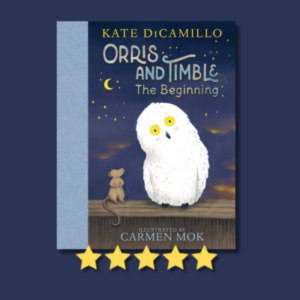
I highly recommend this book for early readers transitioning into chapter books or as a great read-aloud at home or in school. Kids will absolutely adore the full-color illustrations by Carmen Mok. The cover features the rat and owl looking affectionately at one another, which is an immediate draw for animal lovers. Even upper elementary readers (including struggling readers) will enjoy this short and sweet story.
The book explores themes of overcoming nervousness and emotional vulnerability. It shows readers that even if you are quiet and tend to stay in the background, you can still be brave and helpful. Luckily, this is a series, so there are more books to show how this unexpected friendship grows!
🥗 The “Noble Choice” & Natural Instincts
The core conflict of the book is the Predator-Prey Relationship. In nature, an owl would typically hunt a rat, making Orris’s decision to help truly “noble.”
- Instinct vs. Ethics: Orris has to fight his biological urge to hide. By choosing to help, he moves from a “survival mindset” to an “empathy mindset.”
- The Sardine Tin: This object serves as Orris’s moral compass. It’s a clever way to show how even small, discarded things can inspire great character traits.
- Vulnerability: Timble is a “predator,” but in the trap, he is completely helpless. This allows Orris to see the individual rather than the threat.
🎒 Classroom & Curricular Connections
- Social-Emotional Learning (Bravery & Kindness):
- Activity Idea: “My Noble Choice.” Have students draw a time they felt nervous but decided to do the right thing anyway. Like Orris, what was their “motto” or thought that helped them be brave?
- Science (Food Chains & Habitats):
- Activity Idea: Research the relationship between owls and rats in a real barn ecosystem. Discuss why their friendship in the book is so surprising. You could even look at “Owl Pellets” to see what owls usually eat!
- ELA (Character Motivation & Symbols):
- Activity Idea: Discuss the sardine tin. Why do the words “Make the good and noble choice” mean so much to Orris? Have students find an everyday object and create a “Noble Motto” for it.
- Visual Literacy (Carmen Mok’s Illustrations):
- Activity Idea: Look at the expressions Carmen Mok gives Orris and Timble. How do the pictures help us know that Orris is scared but Timble is hopeful? Use “Visual Thinking Strategies” to analyze a specific page.