 Published: 2022
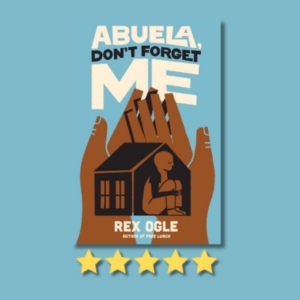
Author: Rex Ogle
Genre: Non-Fiction Memoir / Novel in Verse
Audience: Grades 9–12 (High School)
Number of Stars: ★★★★★ (5/5)
Goodreads Link: Abuela, Don’t Forget Me
Content/Trigger Warnings: Graphic domestic violence, child abuse, systemic racism, brief mentions of drug/alcohol abuse, and suicidal ideation.
Diversity: Explores biracial/Hispanic identity, generational trauma, poverty, and systemic discrimination in the American South.
Review by: Stephanie Kenific
Publisher’s Summary
In his memoir Free Lunch, Rex Ogle’s abuela features as a source of love and support. In this companion memoir-in-verse, Rex captures and celebrates the powerful presence a woman he could always count on—to give him warm hugs and ear kisses, to teach him precious words in Spanish, to bring him to the library where he could take out as many books as he wanted, and to offer safety when darkness closed in. Throughout a coming of age marked by violence and dysfunction, Abuela’s red-brick house in Abilene, Texas, offered Rex the possibility of home, and Abuela herself the possibility for a better life.
Review
What a truly wonderful, moving little book this is! While it is entirely possible to fly through this slim, told-in-verse memoir in a single sitting, you won’t actually want to rush your way through it.
Although Rex’s deeply abusive and manipulative mother looms heavily over the text, Ogle writes completely unflinchingly of the physical and psychological abuse he experienced at her hands, while beautifully contrasting it with the immense tenderness offered to him by his abuela. Rex’s Abuela remains a constant source of psychological uplift and emotional love, even when her efforts are actively hampered by her own toxic daughter.
I deeply appreciated how nuanced the writing around Rex, his mother, and his abuela was. Rex hardly ever relies on cheap adjectives to describe his mother or narrate her outbursts; instead, he simply presents the facts of the abuse exactly as they happened in his memory. Heartbreakingly, too, he describes his abuela’s constant, enabling attempts to support her own daughter, demonstrating a fierce generosity that, at times, accidentally does far more harm than good.
Rex’s relationship with his abuela is deeply complex. She is, without a doubt, the most important and influential person in his entire life. At the same time, because Rex is routinely bullied for his Hispanic identity at school, he develops an internalized embarrassment regarding his abuela, going so far as to avoid being seen with her in public during his pre-teen and early teen years. Abuela gracefully rolls with these slights, advising Rex not to get too caught up in the volatile social politics of middle and high school society, while constantly urging him to reach higher for academic and personal success.
The narrative details agonizing periods of estrangement where Rex’s mother forcibly keeps the two apart, driven by blatant jealousy over their emotional closeness. However, his mother’s turbulent lifestyle always inevitably leads them right back to Abuela’s doorstep in Abilene to beg for financial and domestic help. True to her nurturing nature, Abuela consistently accommodates both Rex and his mother, even going as far as signing her own name on car titles and apartment leases for her daughter. The ultimate consequences of Abuela’s unconditional selflessness and her desperate desire to protect her child turn out to be catastrophic.
Overall, this is an incredibly authentic, beautifully transparent, and lovingly written ode to Rex’s grandmother—and to all the abuelas (whether blood-related or chosen) who provide marginalized young people with a vital source of stability, safety, and care. Young people will definitely find this to be a highly relatable text written in a beautifully approachable poetic style. I would highly recommend it to just about everyone.
🎒 Classroom & Curricular Connections
- English Language Arts (The Structural Power of Memoir-in-Verse):
- Activity Idea: “Stanzas of Survival.” Have students analyze how Ogle uses brief, minimalist lines to convey immense trauma without relying on descriptive adjectives. Have students write a short narrative poem about a core memory of safety or mentorship using free verse, focusing entirely on sensory details (like Abuela’s “ear kisses” or a specific comfort food) rather than emotional labels.
- Social Studies & Sociology (Analyzing Demographics of Modern Caregiving):
- Activity Idea: “The Grandparent Safety Net.” Ogle’s memoir highlights a widespread structural reality in American households. Provide students with current data regarding multi-generational homes.
- U.S. Household Statistics: According to data from the U.S. Census Bureau, approximately 7 million grandparents live with grandchildren under the age of 18. Among them, roughly 2.1 million are “grandparent caregivers” who bear primary responsibility for meeting their grandchildren’s basic daily needs due to parental economic hardship, substance struggles, or domestic instability.
- Activity Idea: Have students create an informational infographic or chart depicting how kinship care serves as a vital social safety net for youth facing domestic displacement.
- Counseling & Social-Emotional Learning (Overcoming Internalized Bias):
- Activity Idea: “Unpacking Schoolyard Assimilation.” Rex admits to feeling ashamed of his grandmother due to the systemic racism and bullying he faced at school. Lead a safe, empathetic classroom discussion regarding peer pressure, racial assimilation, and the pain of turning away from one’s heritage to fit into a dominant culture. Have students write a reflective journal entry on how communities can better honor and protect elder immigrants and familial history.