 Published: 2021
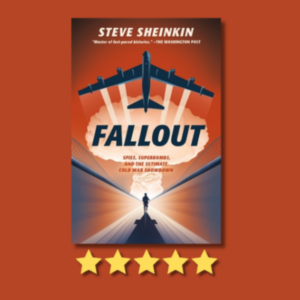
Author: Steve Sheinkin
Genre: Narrative Non-Fiction / Cold War Espionage / Military History
Audience: Grades 7–12 (Middle School & High School)
Number of Stars: ★★★★★ (5/5)
Goodreads Link: Fallout: Spies, Superheroes, and the Ultimate Cold War Showdown
Themes: Geopolitical Dominance, Nuclear Escalation, Covert Espionage, Political Brinkmanship, Subverting History Textbooks.
Review by: MaryAlice Brennan-Steere
Publisher’s Summary
Author Steve Sheinkin presents a follow up to his award-winning book Bomb: The Race to Build–and Steal–the World’s Most Dangerous Weapon, taking readers on a journey into the Cold War and our mutual assured destruction.
As World War II comes to a close, the United States and the Soviet Union emerge as the two greatest world powers on extreme opposites of the political spectrum. After the United States showed its hand with the atomic bomb in Hiroshima, the Soviets refuse to be left behind. With Communism sweeping the globe, the two nations begin a neck-and-neck competition to build even more destructive bombs and conquer the Space Race. In their battle for dominance, spy planes fly above, armed submarines swim deep below, and undercover agents meet in the dead of night. The Cold War game grows more precarious as weapons are pointed towards each other, with fingers literally on the trigger. The decades-long showdown culminates in the Cuban Missile Crisis, the world’s close call with the third—and final—world war.
Review
This exceptional book by Steve Sheinkin delves deeply into critical historical events like the disastrous Bay of Pigs invasion, the high-stakes Cuban Missile Crisis, the physical and ideological division of East and West Germany, and the intense, personal power struggles between President John F. Kennedy and Soviet Premier Nikita Khrushchev. Sheinkin’s undeniable expertise in narrative non-fiction writing shines through brightly on every single page, making the complex historical narrative both profoundly informative and thoroughly engaging.
If only standard middle and high school Social Studies textbooks were as completely captivating as this book! It is highly worth noting that Sheinkin is actually a former textbook writer himself; he has openly shared that he was never able to include all of these fascinating, humanizing details in standard educational curriculum frameworks, which is exactly why he channels them into standalone historical books like this one.
Throughout Fallout, Sheinkin uncovers an absolute wealth of lesser-known historical facts from this terrifying period. He reveals in striking detail just how perilously close the global community came to launching World War III and triggering a total nuclear catastrophe in October 1962. Particularly noteworthy and highly entertaining are the strange-but-true subplots, such as the real-life story of a Soviet spy who managed to operate completely disguised as a standard New York City librarian, and the accidental role an ordinary newspaper delivery boy played in completely exposing a covert Soviet spy ring operating inside the United States.
This book reads precisely like a thrilling, fast-paced spy novel—except for the mind-blowing fact that all of the depicted events are entirely true. It is highly recommended for students, educators, and anyone else looking for a riveting, historical page-turner.
🎒 Classroom & Curricular Connections
- U.S. History & Government (The Logic of Mutual Assured Destruction):
- Activity Idea: “Thirteen Days on the Brink.” Have students read Sheinkin’s breakdown of the Cuban Missile Crisis alongside real, declassified transcripts of JFK’s ExComm meetings. Have students map out the options presented to the President (blockade vs. airstrike) and evaluate the ethical and existential risks of nuclear brinkmanship using a decision-tree matrix.
- Media Literacy & Journalism (The Hollow Coin Case):
- Activity Idea: “The Anatomy of a Cold War Scoop.” Research the true story of Jimmy Bozart, the newspaper boy mentioned in the review who discovered the hollow Soviet nickel in 1953. Have students act as investigative journalists, writing a front-page news article detailing how a mundane daily routine accidentally cracked the Soviet “Hollow Nickel Spy Ring” (the Rudolf Abel case), focusing on gathering objective historical evidence.
- World Geography & Civics (The Visual History of Berlin):
- Activity Idea: “The Geography of Containment.” Use the book’s chapters on Germany to analyze why Berlin became the physical epicenter of the Cold War. Have students analyze maps of occupied Germany, drawing timelines that trace how the city transformed from a shared post-WWII administrative zone into a barricaded symbol of ideological warfare.