 Published: 2020
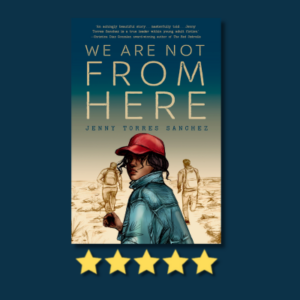
Author: Jenny Torres Sanchez
Genre: Young Adult Realistic Fiction / Social Justice Literature
Audience: Grades 11–12 (Mature High School / Young Adult)
Number of Stars: ★★★★★ (5/5)
Goodreads Link: We Are Not From Here
Content/Trigger Warnings: Severe gang violence, murder, physical abuse, sexual assault, and harrowing depictions of survival conditions.
Themes: The Migrant Journey, Survival Against Extremes, Found Family, Human Rights, Global Citizenship.
Review by: Heather Kent
Publisher’s Summary
A ripped-from-the-headlines novel of desperation, escape, and survival across the U.S.-Mexico border. Pulga, Chico, and Pequeña have no false illusions about the town they’ve grown up in and the dangers that surround them. Though their families–both biological and found–create a warm community for them, threats lurk around every corner. And when those threats become all too real, the three teens know they have no choice but to run: for the border, for the hope of freedom, and for their very lives.
Crossing from Guatemala through Mexico with their eyes on the U.S. border, they follow the route of La Bestia, a system of trains that promise the hope of freedom–if they are lucky enough to survive the harrowing journey. With nothing but the bags on their backs and the desperation that courses through their very veins, Pulga, Chico, and Pequeña know that there’s no turning back, dangerous though the road ahead might be. In this story inspired by real–and current–events, the plight at our southern border is brought to life.
Review
As a World Language teacher who has thoroughly explored border crossing narratives in the classroom, I found We Are Not From Here by Jenny Torres Sanchez to be an exceptionally compelling, vital novel. It brilliantly and brutally depicts the migratory journey undertaken by three young characters traveling from Guatemala all the way to the United States.
What truly sets this novel apart from other contemporary texts is its deeply nuanced portrayal of the psychological motivations underlying the choice to leave one’s homeland. Through the raw, unvarnished experiences of Pulga, Chico, and Pequeña, students are given an authentic window into the complex, intersecting factors—ranging from severe economic hardship to relentless gang violence and domestic persecution—that ultimately compel individuals to embark on such extraordinarily dangerous journeys.
I wholeheartedly recommend We Are Not From Here to high school educators seeking to engage upper-level students in deep, meaningful discussions about contemporary social issues. Its unique ability to illuminate the raw, human dimensions of migration makes it an invaluable resource for fostering critical thinking, media literacy, and deep empathy among students.
This novel has the profound potential to serve as an educational catalyst to create meaningful dialogue about our current social and political climate. It naturally prompts students to reflect on their own roles as global citizens and advocates for justice in a divided world. It is a flawless five-star text.
🛤️ Anatomy of Migration: Mapping “La Bestia”
The author structures the characters’ physical journey along a notorious, real-world network of Mexican freight trains, using the geographical progression to mirror the escalating stakes of survival.
- The Reality of Push Factors: The narrative dismantles the political myth that migration is purely an economic preference. By showcasing the immediate physical danger the teens face from local cartels at home, Sanchez framing migration as a necessary, life-saving flight for survival.
- The Train as a Character: La Bestia (The Beast) serves as both a setting and a continuous structural threat. Riding on top of moving freight trains requires constant physical endurance, exposing the teenagers to physical injury, extreme exposure, and criminal syndicates who target vulnerable migrants along the tracks.
🎒 Classroom & Curricular Connections
- World Language & Contemporary Social Studies (Analyzing Real Migration Data):
- Activity Idea: “The Human Dimension of Statistics.” Pair the novel with contemporary global data to help students ground the fiction in real-world contexts.
- U.S. Border Demographics & Asylum Context: According to data tracking migration patterns from Central America’s Northern Triangle (Guatemala, Honduras, and El Salvador), tens of thousands of unaccompanied minors attempt this exact path annually. In recent fiscal tracking cycles, U.S. Customs and Border Protection encountered over 100,000 unaccompanied children at the Southwest border in a single year. Demographically, over 45% of these minors originate from Guatemala, driven by high rates of systemic violence and severe rural food insecurity.
- Have students create an informational infographic that charts the push factors highlighted in the novel alongside current humanitarian statistics, exploring how non-governmental organizations (NGOs) assist migrants along the trail.
- English Language Arts & Literature (Deconstructing Narrative Suspense):
- Activity Idea: “Ripped from the Headlines.” Discuss how Sanchez utilizes a hyper-realistic, documentary-style writing tone to elevate the suspense of the book. Have students select a specific chapter—such as a sequence where the characters are dodging authorities or boarding La Bestia—and write an objective literary analysis detailing how the author uses sensory pacing (sound, thirst, heat) to convey the constant undercurrent of fear.
- Civics & Global Studies (The Universal Declaration of Human Rights):
- Activity Idea: “Defining a Refugee.” Have students read excerpts from the 1951 Refugee Convention and Article 14 of the UN Universal Declaration of Human Rights (which states that everyone has the right to seek asylum from persecution). Hold a classroom fishbowl debate evaluating the obstacles Pulga, Chico, and Pequeña encounter, analyzing whether contemporary border policies line up with international humanitarian frameworks.