 Published: 2022
Series: N/A
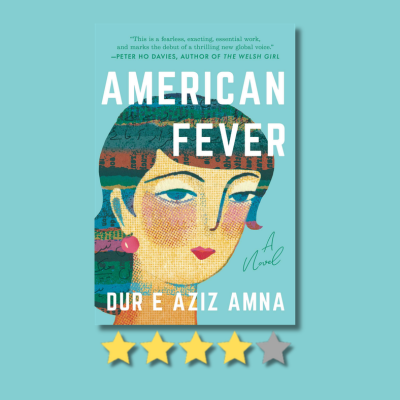
Author: Dur e Aziz Amna
Illustrator: N/A
Genres: Realistic Fiction, Fiction, Pakistan, Young Adult, Coming Of Age, Literary Fiction, Novels, Race, Contemporary, Adult Fiction
Audience (Grade Levels): 11-12
Number of Stars: ⭐⭐⭐⭐ (4/5 Stars)
Goodreads Link: American Fever
Triggers: Islamophobia, strong language
Review By: Stephanie Kenific
Publisher’s Summary:
On a year-long exchange program in rural Oregon, a Pakistani student, sixteen-year-old Hira, must swap Kashmiri chai for volleyball practice and try to understand why everyone around her seems to dislike Obama. A skeptically witty narrator, Hira finds herself stuck between worlds. The experience is memorable for reasons both good and bad; a first kiss, new friends, racism, Islamophobia, homesickness. Along the way Hira starts to feel increasingly unwell until she begins coughing up blood, and receives a diagnosis of tuberculosis, pushing her into quarantine and turning her newly established home away from home upside down.
American Fever is a compelling and laugh-out-loud funny novel about adolescence, family, otherness, religion, the push-and-pull of home. It marks the entrance on the international literary scene of the brilliant fresh voice of Dur e Aziz Amna.
Review:
This is a tricky review to write. There are some very meaningful aspects of American Fever; the narrator, who is in some ways probably derived from the author herself, is a complicated person. As a Pakistani raised in Islam, she describes going through different stages in her faith with two parents who have very different approaches to Islam but who ultimately support her choices. When Hira is chosen for a scholarship exchange program to live in the U.S. for one year, she clings to her muslim identity at first, insisting on fasting for Ramadan and eating a strict halal diet. Hira’s host mother attempts to convince her that she does not “need” to adhere to these religious requirements and even attempts to convince Hira to try out different religions, believing that Islam is oppressive. While her host mother’s attempts to convert her are not impressive, Hira reflects later on the ways that she emphasized her Pakistani identity to keep potential American friends at arm’s length. I thought the complicated nature of Hira’s journey was very worthwhile and definitely something that an American audience could benefit from reading.
At the same time, I picked up this book after reading a review of it in School Library Journal, and I had expected that it would be a young adult book. A mature young person or a young person who is somewhat familiar with the Middle East could still engage with this book, but the language was also very complex. A number of times, I read expressions and references that I didn’t understand and I wonder even if a student from Pakistan would understand. One paragraph that I think exemplifies this well is on page 21: “The hijab was accruing some cachet at school. The sporty head girl wore it, and the Islamiyat teacher had taken to making us clap for every new hijabi in class. There were wider factors at play–the Farhat Hashmization of the new middle class, the commodification of trendy Islamic attire–but these weren’t things my fourteen year-old mind could grapple with.” It might just be that I am not the intended audience, but I would be interested to hear if the complicated rhetoric and language appeal to others.
I would still recommend this book to some. I have two students who are Yemeni and who love to read Islamic authors, even if the reading level is a little beyond their current understanding. I could see those students enjoying the text!
Classroom & Curricular Connections:
- English Language Arts (ELA): The novel’s complex rhetoric and sophisticated prose serve as an excellent text for advanced high school students to analyze tone, voice, and narrative distance. Students can evaluate how Hira’s retrospective perspective handles complicated political and cultural phenomena.
- Social Studies / Global Studies: This story connects directly to lessons on global exchange, immigration, cultural assimilation, and religious pluralism. It provides a unique lens into how American geopolitical dynamics (such as rural-urban divides and Western perceptions of Islam) look to an outside observer.
- Extension Activity / Library Application: This book is an ideal choice for an independent reading selection or a literature circle targeted toward advanced 11th and 12th-grade readers, particularly those interested in immigrant narratives and complex coming-of-age stories. Librarians can pair this book with a research extension where students look into global exchange programs, or use it in a high school book club to unpack the differences between Western expectations of Muslim youth and the lived realities of the characters.
- Diversity & Representation Note: American Fever provides crucial representation by centering an authentic, nuanced Pakistani and Muslim protagonist. Rather than presenting a monolithic view of faith, the book explicitly explores the multi-faceted nature of Islam through Hira’s parents’ differing approaches and her own shifting personal journey. It also confronts heavy realities of racism and Islamophobia head-on, offering American students a meaningful opportunity to engage with international perspectives and systemic biases.
Readalikes:
- The Henna Wars by Adiba Jaigirdar
- If You Could See Me Now by Tanaïs
- Unmarriageable by Soniah Kamal