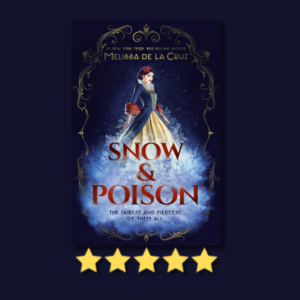
 Published: 2023
Series: Cinder & Glass Companion / Standalone Retelling
Author: Melissa de la Cruz
Genres: Fantasy, Retellings, Young Adult, Romance, Historical Fiction, Fairy Tales, Fiction, Fairy Tale Retellings
Audience (Grade Levels): Middle Grade to Teen / Grades 7-10
Number of Stars: ⭐⭐⭐⭐⭐ (5/5 Stars)
Goodreads Link: Snow & Poison
Triggers: War, Violence, Poison
Review By: Sara Tripp
Publisher’s Summary:
Love is stronger than poison in this lush retelling of “Snow White” by #1 New York Times bestselling author Melissa de la Cruz.
Raven-black hair, red lips, and skin as white as snow—Lady Sophie has led a sheltered life. . . . But that tale ends here. Duchy of Bavaria, 1621. The palace is abuzz with excitement. The widowed Duke Maximilian is marrying a lady named Claudia, and at last, introducing his daughter Sophie to Bavaria’s high society.
At the ball, Sophie charms the dashing Prince Philip, heir to the Spanish throne. But as days pass and Sophie and Philip fall deeply and dangerously in love, the king of Spain orders Philip’s return home and his engagement to a princess. Heartbroken, Sophie finds comfort in Claudia. But might the rumors of her stepmother’s dealings with magic be true? And when conflict between kingdoms puts a target on Sophie’s back, can a vanished witch be the key ally she needs? A new tale begins: one where Sophie must shield her heart, fight for life life, and protect her home.
Review:
Melissa de la Cruz delivers an incredibly imaginative historical remix that gives readers immediate “Disney feels” while breaking away from predictable fairy tale archetypes. The absolute highlight of the novel is the refreshingly positive relationship established between Sophie (Snow White) and her new stepmother, Claudia. By subverting the traditionally malicious “wicked stepmother” trope, de la Cruz allows the reader to root for a blended family unit built on initial trust, warmth, and mutual respect rather than automatic domestic rivalry.
However, the novel experiences significant pacing inconsistencies. The first three-quarters of the book function primarily as a straightforward, well-crafted 17th-century historical romance focused on Sophie’s love affair with Prince Philip and her resistance to arranged noble marriages. The traditional magical mechanisms of the Snow White legend—including the dwarves and the malicious witch archetype—are compressed heavily into the final quarter of the book. This causes the ending to feel rushed, leaving fascinating character developments somewhat glossed over. Despite the uneven structure, younger teens and fans of the author’s previous fairy tale adaptations will still find immense joy in Sophie’s growth into a resilient, self-determined protagonist.
Classroom & Curricular Connections:
- World History & European Studies: Set in the Duchy of Bavaria in 1621, this book offers a great introductory window into 17th-century European court dynamics, foreign political arrangements, and the specific socioeconomic burdens placed on women of noble birth.
- English Language Arts / Structural Analysis: An excellent case study for middle and high school literature courses to analyze narrative structure, mapping out how an uneven distribution of historical romance versus fantasy elements affects a novel’s pacing and payoff.
- Social Emotional Learning (SEL): Highly relevant for discussions surrounding agency, duty, and adapting to new family dynamics, exploring how Sophie navigates external expectations while standing firm in her own choices.
Extension Activity / Library Application:
- Pacing & Expansion Workshop: Pointing to critiques that the final quarter of the book wraps up the Snow White folklore elements too quickly, challenge students to select a rushed scene from the book’s climax (such as the introduction of the dwarves) and expand it into a fully fleshed-out chapter that details deep character backstories.
- The “Anti-Wicked” Trope Critique: Lead a library group discussion on why the subversion of the “wicked stepmother” trope works so effectively in contemporary literature. Have students choose another classic fairy tale antagonist (e.g., the Big Bad Wolf or the Sea Witch) and pitch a historical fiction outline that recontextualizes them as an ally or a misunderstood mentor.
Diversity & Representation:
Though rooted in a traditional European aristocratic setting, this retelling works intentionally to uplift female agency within a historical framework. Sophie is allowed to break free from the passive “damsel” archetype of original Grimm lore, actively safeguarding her home and making her own choices. Additionally, the text serves as a strong modern example of normalizing supportive, healthy dynamics within blended families by painting the stepmother-daughter relationship with nuance and affection.
Readalikes:
- Cinder & Glass by Melissa de la Cruz
- Snow by Tracy Lynn
- Stitching Snow by R.C. Lewis
- Mirror Mirror by Gregory Maguire
- Winter (Lunar Chronicles #4) by Marissa Meyer
Check out the review of book 1 in the series called Cinder & Glass.