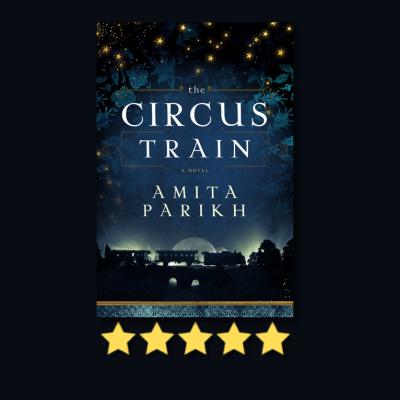
 Published: 2022
Author: Amita Parikh
Genres: Historical Fiction, Fiction, Fantasy, Romance, Historical, World War II, Magical Realism
Audience (Grade Levels): High School / Grades 11-12; Adult
Number of Stars: ⭐⭐⭐⭐⭐ (5/5 Stars)
Goodreads Link: The Circus Train
Triggers: Holocaust, Concentration Camps, Death, Anti-Semitism
Review By: Sara Tripp
Publisher’s Summary:
At the World of Wonders, Europe’s most magnificent travelling circus, every moment is full of magic, and nothing is as it seems—especially for the people who put on the show.
Lena Papadopoulos has never quite found her place within the circus, even as the daughter of the extraordinary headlining illusionist, Theo. Brilliant and curious, Lena yearns for the real-world magic of science and medicine, despite her father’s overprotection and the limits her world places on her because she is disabled. Her unconventional life takes an exciting turn when she rescues Alexandre, an orphan with his own secrets and a mysterious past. Over several years, as their friendship flourishes and Alexandre trains as the illusionist’s apprentice, World War II escalates around them. When Theo and Alexandre are contracted to work and perform in a model town for Jews set up by the Nazis, Lena becomes separated from everything she knows. Forced to make her own way, Lena must confront her doubts and dare to believe in the impossible—herself.
A must-read for fans of The Night Circus and Water for Elephants, The Circus Train will take readers on a heart-wrenching and spectacular two-decade journey across Europe. When all is lost, how do you find the courage to keep moving forward?
Review:
While this book is historical fiction it is more focused on the lives of each character. The three strong characters—Lena Papadopoulos, her father Theo, and a boy who was found on the traveling circus train, Alexandre Robichaud—each have secrets and a past. The circus was magical; the imagery of the train and how they set up the circus really came to life.
The love story between Lena and Alexandre was heartwarming. The physical obstacles Lena faced throughout her childhood led her to such strength as a young adult. The goodness in each of the characters outweighed the sadness of their situation. Theo’s love for his daughter showed the truth behind parenthood—the tough decisions parents have to make to keep their children safe and the self-sacrifice that sometimes requires. This is a great quick read for someone looking for an uplifting book!
“If you think about it, life is like one long maze. Sometimes it’s easy. Sometimes we get stuck. But if you persist, if you can find it within you to endure the hardships, you will reach your goal.” ― Amita Parikh, The Circus Train
Classroom & Curricular Connections:
- World History (WWII & The Holocaust): Serves as a unique, narrative gateway to examine the deceptive propaganda practices of the Nazi regime, specifically looking at how they established “model towns” (such as Theresienstadt) to mask the horrors of concentration camps from international inspectors.
- Health Education & Disability Studies: Offers an excellent platform to analyze historical and social frameworks surrounding physical disabilities in early 20th-century Europe, tracking Lena’s self-determination to break into the male-dominated, ableist fields of science and medicine.
- Language Arts / Character-Driven Lit: Useful for analyzing atmospheric historical fiction and magical realism, studying how the author uses a traveling circus as a micro-setting to ground a macro-historical event.
Extension Activity / Library Application:
- Deconstructing the “Model Town” Propaganda Project: Focus on the section of the book where Theo and Alexandre are forced to perform in a Nazi-controlled “model town.” Have students research the real-world history of Theresienstadt (Terezín), investigating how the regime used coerced arts, theater, and music performances to generate false international red cross reports, comparing historical documentation with Parikh’s narrative.
- The “Science vs. Magic” Character Mapping: Lena rejects traditional circus illusions in favor of science and medicine. Have students build a comparative character chart tracking the thematic intersection of “real-world magic” (science) versus “staged magic” (circus illusions) throughout the novel, analyzing how both concepts serve as survival mechanisms during wartime.
Diversity & Representation:
This historical fiction novel provides intersectional equity by centering on a disabled female protagonist navigating the physical barriers of 1930s and 1940s Europe. Rather than treating her physical condition as a burden or a vehicle for pity, Parikh shapes Lena into a brilliant, scientifically-minded individual whose resilience, internal agency, and intellect drive the narrative forward through global devastation.
Readalikes:
- The Night Circus by Erin Morgenstern
- Water for Elephants by Sara Gruen
- The Orphan’s Tale by Pam Jenoff