 Published: 2023
Series: Lovecraft Country
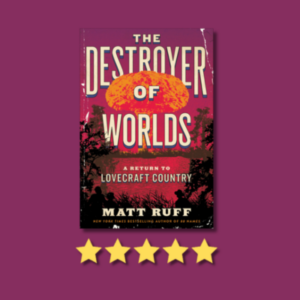
Author: Matt Ruff
Genres: Horror, Fantasy, Fiction, Historical Fiction, Science Fiction, Lovecraftian, Supernatural, Historical, Mystery
Audience (Grade Levels): High School; Grades 9-12; New Adult
Number of Stars: 5 Stars
Goodreads Link: The Destroyer of Worlds
Triggers: Violence, systemic racism/Jim Crow-era discrimination, cancer and terminal illness diagnoses, grief/murder of a friend
Review By: Evan Waugh
Publisher’s Summary:
In this thrilling adventure, a blend of enthralling historical fiction and fantastical horror, Matt Ruff returns to the world of Lovecraft Country and explores the meaning of death, the hold of the past on the present, and the power of hope in the face of uncertainty.
Summer, 1957. Atticus Turner and his father, Montrose, travel to North Carolina to mark the centennial of their ancestor’s escape from slavery, but an encounter with an old nemesis leads to a life-and-death pursuit. Back in Chicago, George Berry is diagnosed with cancer and strikes a devil’s bargain with the ghost of Hiram Winthrop, who promises a miracle cure—but only if George brings Winthrop back from the dead. Fifteen-year-old Horace Berry, reeling from the killing of a close friend, joins his mother, Hippolyta, and her friend Letitia Dandridge on a trip to Nevada for The Safe Negro Travel Guide. But Hippolyta has a secret—and far more dangerous—agenda that will take her and Horace to the far end of the universe and bring a new threat home to Letitia’s doorstep.
Hippolyta isn’t the only one keeping secrets. Letitia’s sister, Ruby, has been leading a double life as her white alter ego, Hillary Hyde. Now, the supply of magic potion she needs to transform herself is nearly gone, and a surprise visitor throws her already tenuous situation into complete chaos. Yet these troubles are soon eclipsed by the return of Caleb Braithwhite. Stripped of his magic and banished from Chicago at the end of Lovecraft Country, he’s found a way back into power and is ready to pick up where he left off. But first he has a score to settle . . .
Review:
In this sequel to his hit book, Lovecraft Country, which has since been adapted into a popular show by JJ Abrams, Matt Ruff returns to the city of Chicago and his ensemble cast of characters, who must face the racism of the 50s while also contending with magical, otherworldly forces.
I had a lot of fun reading this book. While I initially had to read a brief synopsis of the first book, Lovecraft Country, due to having read it several years ago, I was quickly reminded of how exciting and vibrant Ruff’s setting and characters are. This is the kind of book where the pages fly by, and in what feels like no time at all, you have reached the end.
One of my favorite things about Lovecraft Country was the way that each section of the book felt like a self-contained narrative, almost like an episode out of the science fiction pulp magazines of the decade in which the novel is set. All of the episodes added up to tell a complete story, but any reader who came away reading only one of those sections would be satisfied. Unfortunately, Matt Ruff does not continue this style of storytelling in The Destroyer of Worlds: while the novel is separated into several sections, they are done merely to serve the overall narrative, and therefore do not feel like distinct episodes. In all, The Destroyer of Worlds, and its predecessor, should be enjoyed by all.
Classroom & Curricular Connections:
- U.S. History (The Jim Crow Era & Black Travel): The book is an excellent historical asset for studying the realities of the late 1950s United States. The subplot involving The Safe Negro Travel Guide provides an immediate, teachable connection to the real-world historical Negro Motorist Green Book, allowing educators to discuss segregation, sundown towns, and the survival strategies developed by Black Americans traveling through hostile territories.
- English Language Arts (Structural Analysis & Serialized Fiction): The text serves as a strong point of comparison for narrative architecture. Utilizing the reviewer’s critique, teachers can lead a lesson contrasting the structural differences between Lovecraft Country (told via episodic, pulp-magazine style self-contained narratives) and The Destroyer of Worlds (a continuous, interwoven ensemble plot), evaluating how format shifts alter reader pacing and expectations.
Diversity & Representation:
-
The novel powerfully champions diversity, equity, and inclusion by placing a vibrant, multi-generational ensemble cast of Black characters at the absolute center of both an intense historical drama and a cosmic horror epic. By deftly juxtaposing the overt, terrifying systemic racism of the 1950s against malevolent supernatural threats, Ruff honors the profound historical resilience, agency, and complex humanity of Black families navigating intersectional trauma during the Jim Crow era.
Readalikes:
- Lovecraft Country by Matt Ruff
- Ring Shout by P. Djèlí Clark
- The City We Became by N.K. Jemisin