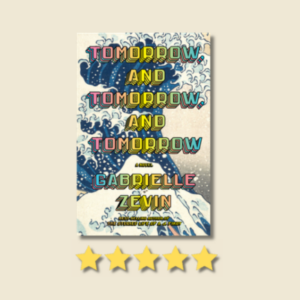
 Published: 2022
Author: Gabrielle Zevin
Genres: Fiction, New Adult, Contemporary, Literary Fiction, Book Club, Romance, Historical Fiction, Adult, Coming Of Age, Friendship
Audience (Grade Levels): High School (Grades 11-12)
Number of Stars: 5-Stars
Goodreads Link: Tomorrow, and Tomorrow, and Tomorrow
Triggers: Domestic violence, gun violence, suicide
Review By: Evan Waugh
Publisher’s Summary:
In this exhilarating novel, two friends—often in love, but never lovers—come together as creative partners in the world of video game design, where success brings them fame, joy, tragedy, duplicity, and, ultimately, a kind of immortality.
On a bitter-cold day, in the December of his junior year at Harvard, Sam Masur exits a subway car and sees, amid the hordes of people waiting on the platform, Sadie Green. He calls her name. For a moment, she pretends she hasn’t heard him, but then, she turns, and a game begins: a legendary collaboration that will launch them to stardom. These friends, intimates since childhood, borrow money, beg favors, and, before even graduating college, they have created their first blockbuster, Ichigo. Overnight, the world is theirs. Not even twenty-five years old, Sam and Sadie are brilliant, successful, and rich, but these qualities won’t protect them from their own creative ambitions or the betrayals of their hearts.
Spanning thirty years, from Cambridge, Massachusetts, to Venice Beach, California, and lands in between and far beyond, Gabrielle Zevin’s Tomorrow, and Tomorrow, and Tomorrow is a dazzling and intricately imagined novel that examines the multifarious nature of identity, disability, failure, the redemptive possibilities in play, and above all, our need to connect: to be loved and to love. Yes, it is a love story, but it is not one you have read before.
Review:
While reading Zevin’s novel, Tomorrow, and Tomorrow, and Tomorrow, I was immediately invested in the story of two college students who set about designing their own video game. As a lifelong gamer, the nostalgic references to familiar titles of the past and present were equally rewarding and heartwarming, and evoked fond memories of playing classic video games – including Bubble Bobble, for anyone who is familiar – with my father as a young boy. Undoubtedly, students will find Tomorrow to be equally relevant. Aside from the very relevant story set in the world of game development, as well as the frequent nods to pop culture titans, Tomorrow also exceeds in its ability to create strong characters. And, indeed, at the center of this story are the characters, who are strong (Sadie Green, who is trying to create a name for herself in a male-dominated industry), flawed (Seth Mazer, who has survived untold loss and trauma), and downright revolting (the self-proclaimed Dov, who acts as a gatekeeper for those looking to enter into the world of video game production). This cast of characters come together to create a story that is captivating from the first page, as readers become invested in the wins, losses, and heartbreaks of all those who live and breathe on the page.
Classroom & Curricular Connections:
- English Language Arts / Media Literacy (Gender Barriers in Technology & Media): This contemporary novel serves as an excellent case study for upper-level high school students analyzing workplace representation and industry hierarchies. Teachers can use Sadie Green’s arc to investigate the historical and ongoing challenges women face while striving to build authoritative names for themselves in male-dominated creative and technical spaces.
- Social Studies / Modern History (Pop Culture & Societal Evolution): Spanning thirty years of contemporary history, the narrative chronicles the rapid structural evolution of digital art, gaming, and technology. Educators can map this timeline alongside cultural history units to show how shared technological experiences and collective retro media actively forge generational subcultures and definitions of community.
- Social-Emotional Learning (Navigating Trauma, Disability, & Ambition): Through its exploration of Sam Masur’s experience with physical disability and childhood trauma, the text presents vital opportunities for SEL modules. Students can discuss how creative partnerships can act as vehicles for emotional resilience, while evaluating how underlying grief, identity complications, and unchecked corporate ambitions threaten interpersonal communication.
Diversity & Representation:
-
Tomorrow, and Tomorrow, and Tomorrow significantly enriches diversity and inclusion by dealing intricately with invisible and visible disabilities, chronic physical pain, and Jewish-Korean-American intersectional identity. By positioning a physically disabled protagonist and a complex female technical director as the brilliant architects of a global industry, the book avoids superficial tokenism, providing older adolescents with a profound representation of creative parity, authentic resilience, and multi-layered relationships.
Readalikes:
- The Amazing Adventures of Kavalier & Clay by Michael Chabon
- Slay by Brittney Morris
- Writers & Lovers by Lily King