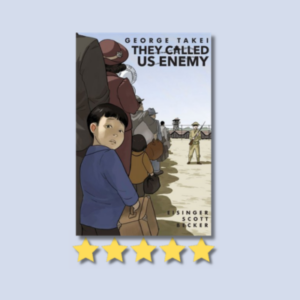
 Published: 2019
Author: George Takei, Justin Eisinger, Steven Scott
Illustrator: Harmony Becker
Genres: Graphic Novels, Nonfiction, Memoir, History, Comics, Biography, Historical, War, World War II
Audience (Grade Levels): Middle Grade, Young Adult; Grades 7–12
Number of Stars: 5-Stars
Goodreads Link: They Called Us Enemy
Triggers: Imprisonment, institutional racism, war-related violence, xenophobia
Review By: Karen Fenner
Publisher’s Summary
Long before George Takei braved new frontiers in Star Trek, he woke up as a four-year-old boy to find his own birth country at war with his father’s—and their entire family forced from their home into an uncertain future.
In 1942, at the order of President Franklin D. Roosevelt, every person of Japanese descent on the west coast was rounded up and shipped to one of ten “relocation centers,” hundreds or thousands of miles from home, where they would be held for years under armed guard.
They Called Us Enemy is Takei’s firsthand account of those years behind barbed wire, the joys and terrors of growing up under legalized racism, his mother’s hard choices, his father’s faith in democracy, and the way those experiences planted the seeds for his astonishing future.
Review:


This is a remarkable story and is truly enhanced by the black and white illustrations which provide images of the bleak camps used to imprison Japanese Americans during World War II as well as the appalling living conditions they had to endure with their families. Takei tells the story from his four-year-old perspective which only enhances the confusion, fear, and indignities they suffered and provides a different way of understanding the loss and horrors that the families faced. The resilience of the adults and children while imprisoned is astounding and highlights the degree of injustice faced at the hands of the United States Government. It is both a cautionary tale and a lesson in courage and fortitude. The graphic novel format is an accessible format for readers who may not know much about the shameful chapter in our history.
From a professional standpoint, this graphic memoir is an exceptional resource for school libraries and classrooms serving grades 7 through 12. Young adult readers are immediately drawn in by the familiar, legendary status of George Takei, only to be deeply moved by the stark historical reality of his childhood. The pacing is superb, shifting seamlessly between the confusing sensory memories of a small child—like mistaking searchlights for playful beams—and the reflective, mature commentary of Takei as an adult activist processing his father’s enduring faith in American democracy. Becker’s illustration style is highly effective; the clean lines, expressive character faces, and deep grayscale shading evoke a somber, cinematic mood that words alone cannot capture. This visual approach helps bridge the gap for striving readers while adding sophisticated subtext for older students analyzing visual storytelling. It is an essential purchase that will rarely sit idle on library shelves.
Classroom & Curricular Connections:
- Social Studies / US History (World War II Homefront & Executive Order 9066): This memoir serves as an invaluable primary-adjacent source for teaching the history of Japanese American incarceration. It provides direct insight into how government policy affected citizens on a personal, systemic level, helping students analyze constitutional rights, wartime hysteria, and civil liberties.
- English Language Arts (Graphic Memoirs & Narrative Perspective): Teachers can utilize this text to study memoir writing, contrasting the narrative voice of an adult reflecting on history with the innocent, limited perspective of a four-year-old child experiencing events in real-time.
- Social-Emotional Learning (Courage, Family Resilience, and Justice): The book offers rich opportunities to discuss how families maintain dignity under oppressive conditions, the weight of difficult moral choices made by parents, and how childhood trauma can be channeled into lifelong advocacy and civic courage.
- “Seeds of Activism” Research Project: Pair the reading of the book with research into George Takei’s lifelong advocacy work. Have students map out how his childhood experiences in the camps directly influenced his modern-day fights for civil rights, LGBTQ+ equality, and historical preservation.
Diversity & Representation:
They Called Us Enemy provides crucial representation of the Japanese American experience during World War II, a historical narrative that is frequently marginalized or glossed over in traditional textbooks. By centering the lived experiences of a Japanese American family navigating legalized racism and xenophobia, the book fosters deep cultural empathy and challenges readers to examine issues of citizenship, identity, belonging, and institutional prejudice in American history.
Readalikes:
- Displacement by Kiku Hughes
- Farewell to Manzanar by Jeanne Wakatsuki Houston and James D. Houston
- When the Emperor Was Divine by Julie Otsuka