 Published: 2023
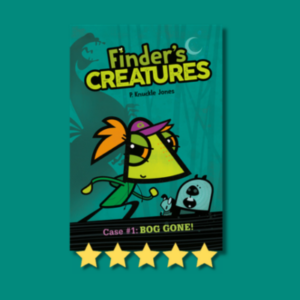
Author/Illustrator: P. Knuckle Jones
Genre: Elementary Graphic Novel / Mystery
Audience: Grades 2–4
Number of Stars: ★★★★★ (5/5)
Goodreads Link: Finder’s Creatures: Bog Gone
Publisher’s Summary
Meet detective-in-training Finder and her friends as they try to figure out why everyone in Belly Acre Bog has disappeared in this hilarious graphic novel mystery! Perfect for fans of The InvestiGators!
Finder the tree frog absolutely loves solving mysteries. So when all the animals in Belly Acre Bog mysteriously disappear overnight, Finder and her friends Chopper and Keeper are toad-ally on the case. But when Seymour Warts, the world’s greatest detective and Finder’s hero, arrives on the scene and begins his own investigation, the young creature finders soon realize that this mystery could be even bigger than their little bog!
Full Review
Finder is a young, aspiring frog detective who sets out to solve a mystery with the help of her resourceful friends. Together, the team faces various challenges as they investigate the sudden disappearance of their friends and family from the bog where they live. Parallel to the young animals solving their mystery, there is a secondary (but related) mystery being solved by Finder’s role model, Seymour Warts. These sections utilize a distinct color palette which helps young readers more easily differentiate the storylines as the narratives switch back and forth.
This book was a hit with my elementary school-aged daughter. She was particularly captivated by the illustrated characters (especially “Keeper,” a young turtle with large, expressive eyes) and was engaged in the story from start to finish. Since she is currently learning about frogs and other amphibians in school, this book was of particular interest to her. I would recommend this book for educators looking to supplement their curriculum on swamps or amphibians to further capture students’ imaginations.
As a parent and educator, I appreciated the inclusion of higher-level vocabulary to stretch students’ knowledge. I also appreciated the fact that the speech bubbles were color-coded depending on which character was speaking. The story was also peppered with puns which led to fun conversations while reading with my daughter. The illustration style and color palette strike a perfect balance of not being overly cutesy while remaining vibrant, making this book universally appealing. Overall, Bog Gone would be a solid addition to any elementary library.
🔍 Reading the Graphic Novel: Visual Literacy Tools
Graphic novels are excellent tools for developing visual literacy in early readers. P. Knuckle Jones uses several clever techniques to make Bog Gone accessible:
- Color-Coded Speech Bubbles: This helps young readers track “who is talking” without needing to rely solely on the text.
- Distinct Color Palettes: By using different color schemes for the two parallel mysteries (Finder’s vs. Seymour Warts’), the author helps students maintain a mental map of the plot transitions.
- Expressive Character Design: Large, emotive eyes and body language allow students to infer character emotions even when they are just beginning to tackle more complex vocabulary.
🎒 Classroom & Curricular Connections
- Science (Amphibian Life Cycles): The book serves as a great bridge between fiction and life science.
- Activity Idea: Conduct a mini-research project on “Belly Acre Bog” animals. Have students compare the fictionalized characters to real-life frogs, turtles, and other bog-dwelling creatures.
- ELA (Vocabulary & Puns): The reviewer noted the inclusion of higher-level vocabulary and puns.
- Activity Idea: Create a “Pun-tastic” vocabulary log. As students find puns (like “toad-ally”), have them define the original word and explain why the pun is funny.
- Graphic Novel Study (Narrative Structure):
- Activity Idea: Since there are two concurrent mysteries, have students create a “Storyboard Map” showing the two plotlines. When and why do they intersect?
- Art/Comics: * Activity Idea: Have students draw a “missing” notice for one of the animals in the bog, using the art style of the book to describe what they look like and where they were last seen.