 Published: 2024
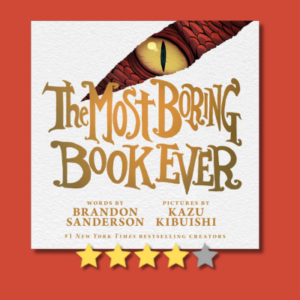
Author: Brandon Anderson | Illustrator: Kazu Kibuishi
Genre: Picture Book / Fantasy / Humor
Audience: Grades K–5
Number of Stars: ★★★★☆ (4/5)
Goodreads Link: The Most Boring Book Ever
Publisher’s Summary
In this humorous epic adventure, a boy is having an ordinary day. He does his math homework, completes his chores, and takes a nap… all while a surprising adventure unfolds around him involving pirates, dragons, and other unexpected perils. With clever interplay between text and art and an expansive, imaginative arc, this book is a landmark fantasy picture book that challenges everything you think you know about “boring” stories.
Review
The Most Boring Book Ever is actually anything but boring—and that’s what makes it so fun. It’s funny, unpredictable, and plays with your expectations right from the very first page.
The book leans into the idea of not judging a book by its cover. It insists it’s boring and not worth your time, but then does the exact opposite with all its clever, chaotic moments. That back-and-forth is what makes it so fun to read—and it’s also why it works so well in a classroom.
If you’re a teacher, there’s a lot here you can use. This book is great for starting conversations about how tone shapes meaning. The narrator is sarcastic, playful, and sometimes a little misleading, which makes it easy for students to see that tone matters just as much as the words themselves. It really shows that it’s not just what’s being said, but how it’s said.
It’s also a great way to bring in ELA topics like tone, mood, theme, and even point of view. Students can see how the author’s tone creates a silly, chaotic mood while also supporting the bigger theme about expectations and looking deeper. It’s a fun, natural way to get them thinking more critically about how all these elements work together in a story.
Overall, it’s clever, interactive, and full of opportunities to spark meaningful conversations while keeping students genuinely engaged.
🎭 Literary Concepts: Mastering Tone and Perspective
This book is a masterclass in unreliable narration and ironic tone. By using these techniques, Anderson and Kibuishi teach students that text and image can tell two completely different stories.
- Tone: The narrator’s “boring” tone provides an ironic contrast to the exciting, action-packed illustrations.
- Juxtaposition: When the text describes mundane tasks like “math homework” while the art depicts “pirates and dragons,” students are forced to reconcile two conflicting realities.
- Meta-fiction: The book acknowledges itself as a book, breaking the “fourth wall” to engage the reader directly in its central joke.
🎒 Classroom & Curricular Connections
- ELA (Tone vs. Mood):
- Activity Idea: Have students pick a page. Ask them: “What is the tone of the narrator?” (Sarcastic, deadpan) and “What is the mood of the scene?” (Exciting, adventurous). Why are they different?
- Creative Writing (Show, Don’t Tell):
- Activity Idea: Challenge students to write a paragraph where the words say one thing (e.g., “I was having a very quiet afternoon”), but the drawing describes something entirely different (e.g., a chaotic space battle).
- Critical Thinking (Expectations):
- Activity Idea: Discussion: Why do we judge books by their covers or titles? How does this author’s choice of a “boring” title actually make the book more interesting?
- Visual Literacy:
- Activity Idea: Since Kazu Kibuishi is a renowned graphic novelist, have students analyze his paneling choices. How does the layout guide the eye from the “boring” text to the “exciting” art?